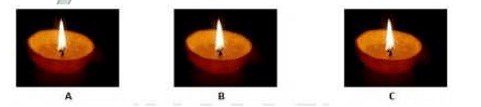
 Three lamps A, B and C as shown in the figure above are burning using oil as its source of energy. Three incense sticks, E, F and G are taken. E is dipped in oil, F is dipped in petrol and G is dipped in water and are immediately placed over the wick of A, B and C respectively. Then
Three lamps A, B and C as shown in the figure above are burning using oil as its source of energy. Three incense sticks, E, F and G are taken. E is dipped in oil, F is dipped in petrol and G is dipped in water and are immediately placed over the wick of A, B and C respectively. Then- A will be put off, B will glow bright and C will be put off
- A will be put off, B will glow bright and C will be put off
- A, B and C will keep glowing
- C will be put off and the status of A and B be cannot determined

The Correct Option is B
Approach Solution - 1
To solve this problem, we need to consider the effects of different substances on the combustion process of oil lamps:
- Lamp A: The incense stick E is dipped in oil and placed on Lamp A. Oil is a flammable substance that aids combustion. However, when the wick is soaked with excess oil, it doesn't allow sufficient air to mix with the fuel, thereby hindering the combustion process. Consequently, Lamp A will be put off.
- Lamp B: The incense stick F is dipped in petrol and placed on Lamp B. Petrol is highly volatile and combusts easily, enhancing the burning process and increasing brightness. Therefore, Lamp B will glow bright.
- Lamp C: The incense stick G is dipped in water and placed on Lamp C. Water is a combustion inhibitor, and it cools down the wick, disrupting the combustion process. Hence, Lamp C will be put off.
Thus, the correct conclusion is that A will be put off, B will glow bright and C will be put off.
Approach Solution -2
Whether a flame at a wick brightens, keeps burning normally, or is smothered depends on how easily the liquid poured onto that wick can catch fire and mix with the surrounding air, that is, how volatile the liquid is.
Lamp A has incense stick E, dipped in oil, placed on its wick. Oil is the same fuel the lamp already burns and is not especially volatile, so adding more of it around the wick chokes the local air supply the flame needs rather than boosting it, putting the flame out. Lamp B has incense stick F, dipped in petrol, placed on its wick. Petrol is highly volatile, evaporating and mixing with air almost instantly, so it feeds the flame extra combustible vapour and makes it burn brighter. Lamp C has incense stick G, dipped in water, placed on its wick. Water does not burn at all and instead cools the wick and blocks oxygen from reaching it, putting the flame out.
So Lamp A is put out, Lamp B glows brighter, and Lamp C is put out.
- Option A (A off, B bright, C off): This matches the outcome worked out above exactly.
- Option B (A off, B bright, C off): This is the identical outcome, also matching what was worked out above.
- Option C (A, B and C will keep glowing): This does not match, since both A and C are put out rather than kept glowing, so this is incorrect.
- Option D (C off, A and B undetermined): This does not match either, since the state of every lamp can in fact be determined, so this is incorrect.
Lamp A is put out, Lamp B burns brighter, and Lamp C is put out, matching the described outcome.
the correct answer is Option B: A will be put off, B will glow bright and C will be put off.
Top SNAP Logical Reasoning Questions
- Four children A, B, C and D are having some chocolates each.
A gives B as many as he already has, he gives C twice of what C already has and he gives D thrice of what D already has.
Now, D gives (\(\frac 18\))th of his own chocolates to B.
Then A gives 10% chocolates he now owns to C and 20% to B.
Finally, all of them have 35 chocolates each. What is the original number of chocolates each had in the beginning? - There are two similar figures below with some numbers. The left one is complete where as one number is missing in the right one. Find a suitable number to fill in place of the question mark.

- Complete the following series by replacing the ?
TBLD, VEPI, XHTN, ? - In a cricket team, three batsmen Ricky, Sachin and Brian are the top three run-scorers in any order. Each of them gives two replies to any question, one of which is true and the other is false, again, in any order. When asked about who the top scorer was, following were the replies they gave:
Sachin : I got the top score. Ricky was second.
Brian : I got the top score. Sachin was second.
Ricky : I got the top score. Sachin was third.
Which of the following is the correct order of batsmen who got the top score, second best and third best score respectively? - 60 employees in an office were asked about their preference for tea and coffee. It was observed that for every 3 people who prefer tea, there are 2 who prefer coffee. For every 6 people who prefer tea, there are 2 who drink both of tea and coffee. The number of people who drink both is the same as those who drink neither.
How many people drink both tea and coffee?
Top SNAP Puzzle Questions
- Four children A, B, C and D are having some chocolates each.
A gives B as many as he already has, he gives C twice of what C already has and he gives D thrice of what D already has.
Now, D gives (\(\frac 18\))th of his own chocolates to B.
Then A gives 10% chocolates he now owns to C and 20% to B.
Finally, all of them have 35 chocolates each. What is the original number of chocolates each had in the beginning? - A, B and C are three students from Don School and P, Q and R are three students fro Elite School. Q is brighter than R but duller than the Don School student who is brighter than A. The same Don School student is duller than P but is brighter than C.
- Ramaswami was studying for his examinations and the lights went off. It was around 1:00 a.m. He lighted two uniform candles of equal length but one thicker than the other. The thick candle is supposed to last six hours and the thin one two hours less. When he finally went to sleep, the thick candle was twice as long as the thin one. For how long did Ramaswami study in candle light?
- The numerator and denominator of a fraction is in the ratio 2:3.If 6 are subtracted from the numerator the value of the fraction becomes \(\frac 23\) of the original fraction.The numerator of the original fraction is,
- A person wanted to withdraw X rupees and Y paise from the bank. But cashier made a mistake and gave him Y rupees and X paise. Neither the person nor the cashier noticed that. After spending 20 paise, the person counts the money. To his surprise, he has double the amount he wanted to
withdraw. Find X and Y. (1 Rupee = 100 Paise)
Top SNAP Questions
- In a retail outlet, the average revenue was Rs.10,000 per day over a 30 day period. During this period, the average revenue on weekends (total 8 days) was Rs. 20,000 per day. What was the average daily revenue on weekdays?
- Two different prime numbers X and Y, both are greater than 2, then which of the following must be true?
- It takes 6 hours for pump A, used alone, to fill a tank of water. Pump B alone takes 8 hours to fill the same tank. A, B and another pump C all together fill the tank in 2 hours. How long would pump C take, used alone, to fill the tank?
- A swimming pool can be filled by pipe A in 3 hours and by pipe B in 6 hours, each pump working on its own. At 9 am, pump A is started. At what time will the swimming pool be filled if pump B is started at 10 am?
- The sum of prime numbers that are greater than 60, but less than 70 is :