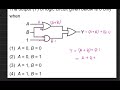
To determine when the output \( Y \) of the given logic circuit is 0, we analyze the circuit’s components and their behavior with inputs \( A \) and \( B \).
Step 1: Identifying Logic Gates From the circuit: - There is an OR gate taking inputs \( A \) and \( B \). - Another OR gate takes input from the output of the first OR gate and a constant input 1. - There is an AND gate with inputs \( A \) and \( B \), whose output feeds into the final OR gate.
Step 2: Analyzing the Behavior of the Circuit 1. The first OR gate outputs 1 if either \( A = 1 \) or \( B = 1 \). The output of this OR gate is 0 only if both \( A = 0 \) and \( B = 0 \). 2. The second OR gate has one input fixed as 1. Since an OR gate outputs 1 if any input is 1, this gate will always output 1 regardless of the input from the first OR gate. 3. The AND gate outputs 1 only if both \( A = 1 \) and \( B = 1 \). In all other cases, it outputs 0. 4. The output \( Y \) is determined by the final OR gate, which takes inputs from the AND gate and the second OR gate. Since the second OR gate always outputs 1, the only way for \( Y \) to be 0 is for all other inputs (AND gate output) to be 0.
Step 3: Condition for \( Y = 0 \) For the output \( Y \) to be 0, the input conditions must be such that the output from the AND gate is 0 (which happens when \( A = 0 \) and \( B = 0 \)).
Therefore, the correct condition is:
\[ A = 0, \, B = 0. \] Hence, the correct option is (2).