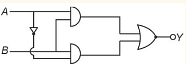
The circuit diagram provided is a logic gate combination circuit. Let's analyze the circuit step-by-step to determine the output \( Y \) for different input combinations of \( A \) and \( B \).
The circuit contains:
An NOT gate inverts the input \( B \).
Two AND gates and one OR gate are used to process the signals.
We will calculate the output for each input combination in the truth table:
Inputs: \( A = 0 \), \( B = 0 \)
The NOT gate inverts \( B \) (0 becomes 1).
The first AND gate has inputs \( A = 0 \) and NOT \( B = 1 \), so its output is \( 0 \cdot 1 = 0 \).
The second AND gate has inputs \( B = 0 \) (inverted becomes 1) and \( A = 0 \), so its output is \( 0 \).
The OR gate processes the outputs \( 0 \) and \( 0 \), resulting in \( Y = 0 \).
Inputs: \( A = 1 \), \( B = 0 \)
The NOT gate inverts \( B \) (0 becomes 1).
The first AND gate has inputs \( A = 1 \) and NOT \( B = 1 \), so its output is \( 1 \cdot 1 = 1 \).
The second AND gate has inputs \( B = 0 \) (inverted becomes 1) and \( A = 1 \), so its output is \( 0 \).
The OR gate processes the outputs \( 1 \) and \( 0 \), resulting in \( Y = 1 \).
Inputs: \( A = 0 \), \( B = 1 \)
The NOT gate inverts \( B \) (1 becomes 0).
The first AND gate has inputs \( A = 0 \) and NOT \( B = 0 \), so its output is \( 0 \).
The second AND gate has inputs \( B = 1 \) (inverted becomes 0) and \( A = 0 \), so its output is \( 0 \cdot 0 = 0 \).
The OR gate processes the outputs \( 0 \) and \( 0 \), resulting in \( Y = 0 \).
Inputs: \( A = 1 \), \( B = 1 \)
The NOT gate inverts \( B \) (1 becomes 0).
The first AND gate has inputs \( A = 1 \) and NOT \( B = 0 \), so its output is \( 0 \).
The second AND gate has inputs \( B = 1 \) (inverted becomes 0) and \( A = 1 \), so its output is \( 1 \cdot 0 = 0 \).
The OR gate processes the outputs \( 0 \) and \( 0 \), resulting in \( Y = 0 \).
Based on the above analysis, the correct truth table is:
The circuit diagram consists of logic gates. By analyzing each gate’s behavior step-by-step and evaluating the output \( Y \) for each input combination of \( A \) and \( B \), we can determine the output for each case. After constructing the truth table for the circuit, we find that the correct output matches option (3).


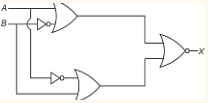 Draw truth table of given gate circuit.

