Question:
Which of the following options is the most appropriate water-image of the figure along MM':
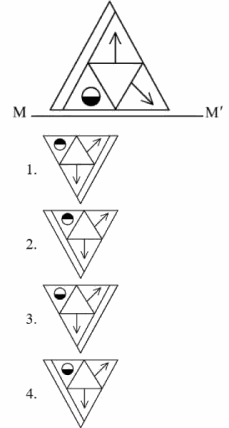
Which of the following options is the most appropriate water-image of the figure along MM':
Updated On: Sep 16, 2026
- Option 1
- Option 2
- Option 3
- Option 4
Show Solution

Verified By Collegedunia
The Correct Option is B
Solution and Explanation
Concept:
Step 1: Study the structure of the original triangle.
The large upward-pointing triangle is split into 4 smaller triangles: the top small triangle holds an upward arrow, the bottom-left holds a circle shaded on its lower half, the bottom-right holds a diagonal arrow pointing down-right, and the middle (upside-down) triangle holds a downward arrow.
Step 2: Flip the whole triangle top to bottom.
After reflecting along the horizontal line MM', the entire triangle turns upside down, so its apex now points downward; the region that was the "top small triangle" now sits at the very bottom tip, and the old "bottom row" now sits at the top.
Step 3: Reverse every internal detail vertically.
The upward arrow becomes a downward arrow and moves to the bottom tip.
The downward arrow becomes an upward arrow and sits in the middle.
The down-right diagonal arrow becomes an up-right diagonal arrow.
The circle's shaded lower half becomes a shaded upper half.
Step 4: Match this fully-reversed figure with the options.
Only one option shows all four of these reversed features together at the correct positions; the rest keep at least one arrow direction or the shaded half of the circle un-reversed.
Final Answer: Option 2
- A water image (reflection in still water) is a top-to-bottom flip along the horizontal line MM': whatever is at the top of the figure appears at the bottom of the image and vice versa, while left and right stay exactly where they were.
- Every arrow must reverse its up/down direction, and a circle shaded on one half must have its shaded half move from bottom to top (or top to bottom).
Step 1: Study the structure of the original triangle.
The large upward-pointing triangle is split into 4 smaller triangles: the top small triangle holds an upward arrow, the bottom-left holds a circle shaded on its lower half, the bottom-right holds a diagonal arrow pointing down-right, and the middle (upside-down) triangle holds a downward arrow.
Step 2: Flip the whole triangle top to bottom.
After reflecting along the horizontal line MM', the entire triangle turns upside down, so its apex now points downward; the region that was the "top small triangle" now sits at the very bottom tip, and the old "bottom row" now sits at the top.
Step 3: Reverse every internal detail vertically.
The upward arrow becomes a downward arrow and moves to the bottom tip.
The downward arrow becomes an upward arrow and sits in the middle.
The down-right diagonal arrow becomes an up-right diagonal arrow.
The circle's shaded lower half becomes a shaded upper half.
Step 4: Match this fully-reversed figure with the options.
Only one option shows all four of these reversed features together at the correct positions; the rest keep at least one arrow direction or the shaded half of the circle un-reversed.
Final Answer: Option 2
Was this answer helpful?
0
0
Top NIFT Verbal and Logical Ability Questions
- A statement is given below followed by two courses of action numbered I and II. Assume everything in the statement to be true and on the basis of the information given in the statement, decide which of the suggested courses of action logically follow the statement.
Statement: The condition of all the major roads in the city 'X' has deteriorated due to continuous rain during the last twenty days.
Courses of Action:
I. The city 'X' civic authority should immediately make arrangements for repairs of the damaged roads.
II. Motorists should be alerted at various places by putting up sign boards about the bad patches of the roads to enable them to plan their journey accordingly. - A company has to recruit an Engineer from among the candidates A, B, C & D. The criteria defined by the company is as follows:
(i) He/She should have B.Tech or a Higher degree in the relevant field with minimum 60% marks.
(ii) Age should not be more than 30 years.
(iii) Experience should be more than 2 years.
The details of the candidates are given below:Name Qualification Age (Yrs.) Experience % Marks in Qualifying degree A B.Tech. 30 2 Years 73% B M.Tech. 31 5 Years 67% C B.Tech. 29 3 Years 70% D M.Tech. 28 3 Years 55% Based on the above mentioned criteria for selection, which candidate is eligible for selection? - Assume the statements to be true even if they seem to be at variance from the commonly known facts. Then decide which of the given conclusions follows from the given statements.
Statements:
All models are fashion designers.
All youtubers are models.
Conclusions:
I. All youtubers are fashion designers.
II. Some models are youtubers. - In a row of boys, Aman is fifteenth from the left end and Dhanush is eighteenth from the right end. If in this row Aman is eleventh from the right end, then what is the position of Dhanush from the left end?
- In the following alpha-numeric series, which option replaces the question mark (?): AZ2, CX4, EV8, GT16, ?
View More Questions
Top NIFT Questions
- Choose the appropriate phrase to replace the underlined part:
If you are thinking about investing, \(\underline{\text{isn't make sense to find an experienced financial advisor?} }\)
- Choose the appropriate phrase to replace the underlined part:
The old man looked \(\underline{\text{with caution before he crossed the busy street.} }\) - Choose the appropriate phrase to replace the underlined part:
The new bank clerk kicked up a row with a senior colleague. - Choose the word with nearly the same meaning as the given word:
NADIR - Choose the word with nearly the same meaning as the given word:
ABSTRUSE
View More Questions