Question:
Three figures (X), (Y) and (Z) show a sequence of folding of a piece of paper. The shaded portion of figure (Z) shows the manner in which the folded paper has been cut. Select the option which would most closely resemble the unfolded form of figure (Z).
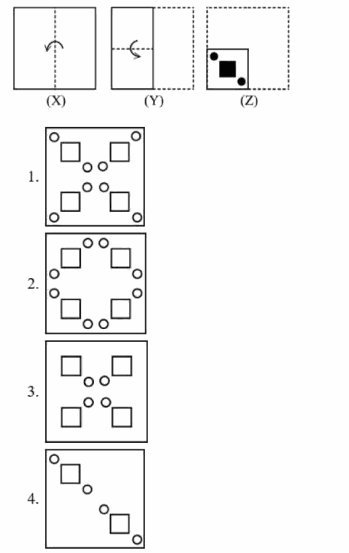
Three figures (X), (Y) and (Z) show a sequence of folding of a piece of paper. The shaded portion of figure (Z) shows the manner in which the folded paper has been cut. Select the option which would most closely resemble the unfolded form of figure (Z).
Updated On: Sep 16, 2026
- Option 1
- Option 2
- Option 3
- Option 4
Show Solution

Verified By Collegedunia
The Correct Option is B
Solution and Explanation
Concept:
Step 1: Trace the folds shown from (X) to (Y) to (Z).
(X) is folded along its vertical centre line to give (Y).
(Y) is folded again along its horizontal centre line to give (Z).
So (Z) is effectively one-quarter of the original sheet, made up of four layers pressed together.
Step 2: Note the cut made on (Z).
A small filled square and a small filled dot are cut near one corner of the folded packet, through all four layers at once.
Step 3: Unfold the paper back, one fold at a time.
Unfolding the horizontal fold reflects the cut across that line, giving two mirrored copies in (Y)'s shape.
Unfolding the vertical fold then reflects that whole pair across the vertical line, giving four mirrored copies in total, one sitting in each quadrant of the full square, each the same distance from both centre lines as the original cut.
Step 4: Match this against the options.
Only the option with a small square at each of the four corners and the dots placed symmetrically about both the vertical and the horizontal centre lines reproduces this double-mirror pattern correctly.
The option showing the shapes repeated only along a single diagonal is wrong, since that layout would come from just one fold, not two perpendicular folds.
Final Answer: The option with squares at all four corners and dots symmetrically placed about both centre lines (option 2)
- In a fold-and-cut question, unfolding the paper reverses the folds one at a time, in the reverse order they were made.
- Every fold line works like a mirror line: a cut made through the folded layers reappears as a mirror-reflected copy across that line once the paper is opened.
- Two folds made along two different (perpendicular) lines mean the cut must reappear as four mirror-matched copies, one in each quarter of the original sheet.
Step 1: Trace the folds shown from (X) to (Y) to (Z).
(X) is folded along its vertical centre line to give (Y).
(Y) is folded again along its horizontal centre line to give (Z).
So (Z) is effectively one-quarter of the original sheet, made up of four layers pressed together.
Step 2: Note the cut made on (Z).
A small filled square and a small filled dot are cut near one corner of the folded packet, through all four layers at once.
Step 3: Unfold the paper back, one fold at a time.
Unfolding the horizontal fold reflects the cut across that line, giving two mirrored copies in (Y)'s shape.
Unfolding the vertical fold then reflects that whole pair across the vertical line, giving four mirrored copies in total, one sitting in each quadrant of the full square, each the same distance from both centre lines as the original cut.
Step 4: Match this against the options.
Only the option with a small square at each of the four corners and the dots placed symmetrically about both the vertical and the horizontal centre lines reproduces this double-mirror pattern correctly.
The option showing the shapes repeated only along a single diagonal is wrong, since that layout would come from just one fold, not two perpendicular folds.
Final Answer: The option with squares at all four corners and dots symmetrically placed about both centre lines (option 2)
Was this answer helpful?
0
0
Top NIFT Verbal and Logical Ability Questions
- A statement is given below followed by two courses of action numbered I and II. Assume everything in the statement to be true and on the basis of the information given in the statement, decide which of the suggested courses of action logically follow the statement.
Statement: The condition of all the major roads in the city 'X' has deteriorated due to continuous rain during the last twenty days.
Courses of Action:
I. The city 'X' civic authority should immediately make arrangements for repairs of the damaged roads.
II. Motorists should be alerted at various places by putting up sign boards about the bad patches of the roads to enable them to plan their journey accordingly. - A company has to recruit an Engineer from among the candidates A, B, C & D. The criteria defined by the company is as follows:
(i) He/She should have B.Tech or a Higher degree in the relevant field with minimum 60% marks.
(ii) Age should not be more than 30 years.
(iii) Experience should be more than 2 years.
The details of the candidates are given below:Name Qualification Age (Yrs.) Experience % Marks in Qualifying degree A B.Tech. 30 2 Years 73% B M.Tech. 31 5 Years 67% C B.Tech. 29 3 Years 70% D M.Tech. 28 3 Years 55% Based on the above mentioned criteria for selection, which candidate is eligible for selection? - Assume the statements to be true even if they seem to be at variance from the commonly known facts. Then decide which of the given conclusions follows from the given statements.
Statements:
All models are fashion designers.
All youtubers are models.
Conclusions:
I. All youtubers are fashion designers.
II. Some models are youtubers. - In a row of boys, Aman is fifteenth from the left end and Dhanush is eighteenth from the right end. If in this row Aman is eleventh from the right end, then what is the position of Dhanush from the left end?
- In the following alpha-numeric series, which option replaces the question mark (?): AZ2, CX4, EV8, GT16, ?
View More Questions
Top NIFT Questions
- Choose the appropriate phrase to replace the underlined part:
If you are thinking about investing, \(\underline{\text{isn't make sense to find an experienced financial advisor?} }\)
- Choose the appropriate phrase to replace the underlined part:
The old man looked \(\underline{\text{with caution before he crossed the busy street.} }\) - Choose the appropriate phrase to replace the underlined part:
The new bank clerk kicked up a row with a senior colleague. - Choose the word with nearly the same meaning as the given word:
NADIR - Choose the word with nearly the same meaning as the given word:
ABSTRUSE
View More Questions