Let \(P1:\overrightarrow{r}.(2\^i+\^j−3\^k )=4\) be a plane. Let \(P_2\) be another plane which passes through points \((2, - 3, 2)\), \((2, - 2, -3)\) and \((1, -4, 2)\). If the direction ratios of the line of intersection of \(P_1\) and \(P_2\) be \(16, α,β,\) then the value of \(α + β\) is equal to _____ .

Correct Answer: 28
Solution and Explanation
Direction ratio of normal to \(P_1≡< 2, 1, – 3 >\)
and \(P2≡\begin{vmatrix} \hat i & \hat j & \hat k \\[0.3em] 0 & 1 & -5 \\[0.3em] -1 & -2 & 5 \end{vmatrix}\)
\(P_2=−5\hat i−\hat j(−5)+\hat k(1)\)
i.e.\(< –5, 5, 1 >\)
d.r’s of line of intersection are along vector
\(\begin{vmatrix} \hat i & \hat j & \hat k \\[0.3em] 2 & 1 & -3 \\[0.3em] -5 & 5 & 1 \end{vmatrix}\)\(=\hat i(16)−\hat j(−13)+\hat k(15)\)
i.e.\(< 16, 13, 15 >\)
Therefore, \(α + β = 13 + 15 = 28\)
So, the answer is \(28\).
Top JEE Main Mathematics Questions
- Let $a_1,a_2,a_3,a_4$ be an A.P. of four terms such that each term of the A.P. and its common difference are integers. If $a_1+a_2+a_3+a_4=48$ and $a_1^2a_2a_3a_4+1^4=361$, then the largest term of the A.P. is equal to
- JEE Main - 2026
- Mathematics
- Arithmetic Progression
- If the coefficient of \( x \) in the expansion of \[ (ax^2 + bx + c)(1 - 2x)^{26} \] is \(-56\) and the coefficients of \( x^2 \) and \( x^3 \) are both zero, then \( a + b + c \) is equal to
- JEE Main - 2026
- Mathematics
- Binomial theorem
- Let \( y = x \) be the equation of a chord of the circle \( C_1 \) (in the closed half-plane \( x \ge 0 \)) of diameter 10 passing through the origin. Let \( C_2 \) be another circle described on the given chord as diameter. If the equation of the chord of the circle \( C_2 \), which passes through the point \( (2, 3) \) and is farthest from the center of \( C_2 \), is \( x + ay + b = 0 \), then \( b \) is equal to:
- JEE Main - 2026
- Mathematics
- Coordinate Geometry
- If \[ \frac{\tan(A-B)}{\tan A}+\frac{\sin^2 C}{\sin^2 A}=1, \quad A,B,C\in\left(0,\frac{\pi}{2}\right), \] then:
- JEE Main - 2026
- Mathematics
- Trigonometry
- Let $z$ be the complex number satisfying $|z - 5| \le 3$ and having maximum positive principal argument. Then $34 \left| \frac{5z - 12}{5iz + 16} \right|^2$ is equal to :
- JEE Main - 2026
- Mathematics
- Complex numbers
Top JEE Main Plane Questions
Let the plane $P : 8 x+\alpha_1 y+\alpha_2 z+12=0$ be parallel to the line $L : \frac{x+2}{2}=\frac{y-3}{3}=\frac{z+4}{5}$. If the intercept of $P$ on the $y$-axis is 1 , then the distance between $P$ and $L$ is :
- A vector $\vec{v}$ in the first octant is inclined to the $x$-axis at $60^{\prime}$, to the $y$-axis at $45$ and to the $z$-axis at an acute angle If a plane passing through the points $(\sqrt{2},-1,1)$ and $(a, b, c)$, is normal to $\vec{v}$, then
- A vector $\vec{v}$ in the first octant is inclined to the $x$-axis at $60^{\prime}$, to the $y$-axis at $45$ and to the $z$-axis at an acute angle If a plane passing through the points $(\sqrt{2},-1,1)$ and $(a, b, c)$, is normal to $\vec{v}$, then
- Let $P$ be the plane, passing through the point $(1,-1,-5)$ and perpendicular to the line joining the points $(4,1,-3)$ and $(2,4,3)$. Then the distance of $P$ from the point $(3,-2,2)$ is
- If the equation of the plane passing through the point $(1,1,2)$ and perpendicular to the line $x-3 y+$ $2 z-1=0=4 x-y+z$ is $A t+ B y+ C z=1$, then $140( C - B + A )$ is equal to______
Top JEE Main Questions
- Let $a_1,a_2,a_3,a_4$ be an A.P. of four terms such that each term of the A.P. and its common difference are integers. If $a_1+a_2+a_3+a_4=48$ and $a_1^2a_2a_3a_4+1^4=361$, then the largest term of the A.P. is equal to
- JEE Main - 2026
- Arithmetic Progression
- If the coefficient of \( x \) in the expansion of \[ (ax^2 + bx + c)(1 - 2x)^{26} \] is \(-56\) and the coefficients of \( x^2 \) and \( x^3 \) are both zero, then \( a + b + c \) is equal to
- JEE Main - 2026
- Binomial theorem
- Water drops fall from a tap on the floor, \(5\) m below, at regular intervals of time. The first drop strikes the floor when the sixth drop begins to fall. The height at which the fourth drop will be from the ground, at the instant when the first drop strikes the ground, is ________ m. (\( g = 10 \, \text{m s}^{-2} \))
- JEE Main - 2026
- Kinematics
- Let \( y = x \) be the equation of a chord of the circle \( C_1 \) (in the closed half-plane \( x \ge 0 \)) of diameter 10 passing through the origin. Let \( C_2 \) be another circle described on the given chord as diameter. If the equation of the chord of the circle \( C_2 \), which passes through the point \( (2, 3) \) and is farthest from the center of \( C_2 \), is \( x + ay + b = 0 \), then \( b \) is equal to:
- JEE Main - 2026
- Coordinate Geometry
- If \[ \frac{\tan(A-B)}{\tan A}+\frac{\sin^2 C}{\sin^2 A}=1, \quad A,B,C\in\left(0,\frac{\pi}{2}\right), \] then:
- JEE Main - 2026
- Trigonometry
Concepts Used:
Distance of a Point from a Plane
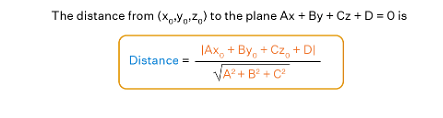
The shortest perpendicular distance from the point to the given plane is the distance between point and plane. In simple terms, the shortest distance from a point to a plane is the length of the perpendicular parallel to the normal vector dropped from the particular point to the particular plane. Let's see the formula for the distance between point and plane.
Read More: Distance Between Two Points