Illustrate the law of conservation of energy by discussing the energy changes which occur when we draw a pendulum bob to one side and allow it to oscillate. Why does the bob eventually come to rest? What happens to its energy eventually? Is it a violation of the law of conservation of energy?

Solution and Explanation
In the case of pendulum energy in the Bob at any instant of time, can be either potential energy (P.E) or kinetic energy (K.E) or a mixture of both but its total energy at any instant of time remains constant. This can be illustrated by below illustration in the figure.
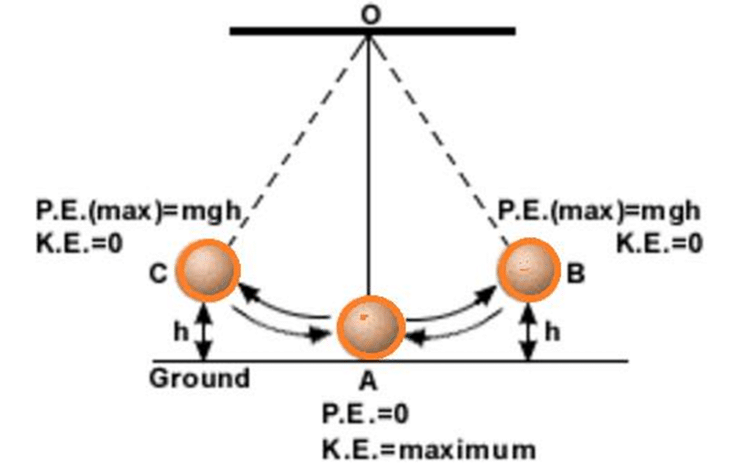
In case of pendulum energy in the Bob at any instant of time when the pendulum Bob is at position B.It has only potential energy(P.E) and no kinetic energy(K.E).
As the Bob starts moving from position B to position A potential energy(P.E) decreases but Kinetic Energy(K.E) increases.
When the Bob reaches position A, there is only kinetic energy(K.e) but no potential energy(P.E).
As Bob moves from position A to position C, potential energy(p.E) increases but kinetic energy decreases.
When Bob reaches position C, Bob stops for a very small instant of time, At that time, Bob has only potential energy but no kinetic energy.
The Bob eventually comes to rest due to the frictional force offered by the air and the rigid support holding the thread.
It is not a violation of the law of conservation of energy since mechanical energy can get converted into another form of energy which cannot be utilized for useful work. This loss of energy is called dissipation of energy.
Top CBSE Class IX Science Questions
- How do good animal husbandry practices benefit farmers?
- CBSE Class IX
- Science
- Animal Husbandry
- Convert the following temperatures to the Celsius scale.
(a) 293 K
(b) 470 K- CBSE Class IX
- Science
- Can Matter Change its State?
- Convert the following temperatures to the Celsius scale.
(a) 293 K
(b) 470 K- CBSE Class IX
- Science
- Can Matter Change its State?
- Give reason for the following observations.
(a) Naphthalene balls disappear with time without leaving any solid.
(b) We can get the smell of perfume sitting several metres away.- CBSE Class IX
- Science
- Physical Nature of Matter
- Arrange the following substances in increasing order of forces of attraction between the particles— water, sugar, oxygen.
- CBSE Class IX
- Science
- Can Matter Change its State?
Top CBSE Class IX Energy Questions
- A battery lights a bulb. Describe the energy changes involved in the process.
- The potential energy of a freely falling object decreases progressively. Does this violate the law of conservation of energy? Why?
- What are the various energy transformations that occur when you are riding a bicycle?
- Does the transfer of energy take place when you push a huge rock with all your might and fail to move it? Where is the energy you spend going?
- A certain household has consumed \(250\) \(units\) of energy during a month. How much energy is this in joules?
Top CBSE Class IX Questions
- The radius of a spherical balloon increases from 7 cm to 14 cm as air is being pumped into it. Find the ratio of surface areas of the balloon in the two cases.
- CBSE Class IX
- Surface Area of a Sphere
(Street Plan) : A city has two main roads which cross each other at the centre of the city. These two roads are along the North-South direction and East-West direction.
All the other streets of the city run parallel to these roads and are 200 m apart. There are 5 streets in each direction. Using 1cm = 200 m, draw a model of the city on your notebook. Represent the roads/streets by single lines. There are many cross- streets in your model. A particular cross-street is made by two streets, one running in the North - South direction and another in the East - West direction. Each cross street is referred to in the following manner : If the 2nd street running in the North - South direction and 5th in the East - West direction meet at some crossing, then we will call this cross-street (2, 5). Using this convention, find:
(i) how many cross - streets can be referred to as (4, 3).
(ii) how many cross - streets can be referred to as (3, 4).
- CBSE Class IX
- Coordinate Geometry
- What are the main features of the mechanical teachers and the schoolrooms that Margie and Tommy have in the story?
- CBSE Class IX
- The fun they had
- “They can’t hang me twice.”
(i) Who says this?
(ii) Why does the speaker say it?- CBSE Class IX
- If I were you
- How do good animal husbandry practices benefit farmers?
- CBSE Class IX
- Animal Husbandry
Concepts Used:
Work-Energy Theorem
The work and kinetic energy principle (also known as the work-energy theorem) asserts that the work done by all forces acting on a particle equals the change in the particle's kinetic energy. By defining the work of the torque and rotational kinetic energy, this definition can be extended to rigid bodies.
The change in kinetic energy KE is equal to the work W done by the net force on a particle is given by,
W = ΔKE = ½ mv2f − ½ mv2i
Where,
vi → Speeds of the particle before the application of force
vf → Speeds of the particle after the application of force
m → Particle’s mass
Note: Energy and Momentum are related by, E = p2 / 2m.