Given below are two statements:
Statement-I : Susceptibilities of paramagnetic and ferromagnetic substances increase with decrease in temperature.
Statement-II : Diamagnetism is a result of orbital motions of electrons developing magnetic moments opposite to the applied magnetic field.
Choose the correct answer from the options given below:-
Given below are two statements:
Statement-I : Susceptibilities of paramagnetic and ferromagnetic substances increase with decrease in temperature.
Statement-II : Diamagnetism is a result of orbital motions of electrons developing magnetic moments opposite to the applied magnetic field.
Choose the correct answer from the options given below:-
- Both Statement-I and Statement-II are true
- Both Statement-I and Statement-II are false
- Statement-I is true but Statement-II is false
- Statement-I is false but Statement-II is true

The Correct Option is A
Solution and Explanation
The correct option is(A): Both Statement-I and Statement-II are true.
Statement-I is true as susceptibility of ferromagnetic and paramagnetic materials is inversely related to temperature.
Statement-II is true as because of orbital motion of electrons the diamagnetic material is able to oppose external magnetic field.
Top JEE Main Physics Questions
- Water drops fall from a tap on the floor, \(5\) m below, at regular intervals of time. The first drop strikes the floor when the sixth drop begins to fall. The height at which the fourth drop will be from the ground, at the instant when the first drop strikes the ground, is ________ m. (\( g = 10 \, \text{m s}^{-2} \))
- JEE Main - 2026
- Physics
- Kinematics
- A block of mass \(5\) kg is moving on an inclined plane which makes an angle of \(30^\circ\) with the horizontal. The coefficient of friction between the block and the inclined plane surface is \(\dfrac{\sqrt{3}}{2}\). The force to be applied on the block so that the block moves {down the plane without acceleration is ________ N. (\( g = 10 \, \text{m s}^{-2} \))}
- JEE Main - 2026
- Physics
- Newtons Laws of Motion
Identify the correct truth table of the given logic circuit.

- JEE Main - 2026
- Physics
- communication systems
- The escape velocity from a spherical planet \(A\) is \(10\ \text{km/s}\). The escape velocity from another planet \(B\), whose density and radius are \(10%\) of those of planet \(A\), is _______ m/s.
- JEE Main - 2026
- Physics
- Gravitation
- A current carrying solenoid is placed vertically and a particle of mass m with charge Q is released from rest. The particle moves along the axis of solenoid. If g is acceleration due to gravity then the acceleration (a) of the charged particle will satisfy:
- JEE Main - 2026
- Physics
- Moving charges and magnetism
Top JEE Main specific heat capacity Questions
Match List-I with List-II.
List-I List-II (A) Heat capacity of body (I) \( J\,kg^{-1} \) (B) Specific heat capacity of body (II) \( J\,K^{-1} \) (C) Latent heat (III) \( J\,kg^{-1}K^{-1} \) (D) Thermal conductivity (IV) \( J\,m^{-1}K^{-1}s^{-1} \) - JEE Main - 2025
- Physics
- specific heat capacity
- Two moles a monoatomic gas is mixed with six moles of a diatomic gas. The molar specific heat of the mixture at constant volume is :
- JEE Main - 2024
- Physics
- specific heat capacity
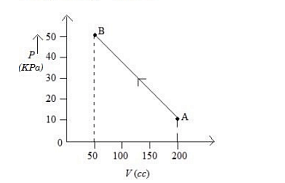
The pressure of a gas changes linearly with volume from $A$ to $B$ as shown in figure If no heat is supplied to or extracted from the gas then change in the internal energy of the gas will be Is
- JEE Main - 2023
- Physics
- specific heat capacity
Let \(\gamma_1\)be the ratio of molar specific heat at constant pressure and molar specific heat at constant volume of a monoatomic gas and \(\gamma_2\) be the similar ratio of diatomic gas. Considering the diatomic gas molecule as a rigid rotator, the ratio, \(\frac{\gamma_1}{\gamma_2}\) is :
- JEE Main - 2023
- Physics
- specific heat capacity
A water heater of power $2000 W$ is used to heat water. The specific heat capacity of water is $4200 J$ $kg ^{-1} K ^{-1}$ .The efficiency of heater is $70 \%$ .Time required to heat $2 kg$ of water from $10^{\circ} C$ to $60^{\circ} C$ is___$ s$
(Assume that the specific heat capacity of water remains constant over the temperature range of the water)- JEE Main - 2023
- Physics
- specific heat capacity
Top JEE Main Questions
- Let $a_1,a_2,a_3,a_4$ be an A.P. of four terms such that each term of the A.P. and its common difference are integers. If $a_1+a_2+a_3+a_4=48$ and $a_1^2a_2a_3a_4+1^4=361$, then the largest term of the A.P. is equal to
- JEE Main - 2026
- Arithmetic Progression
- If the coefficient of \( x \) in the expansion of \[ (ax^2 + bx + c)(1 - 2x)^{26} \] is \(-56\) and the coefficients of \( x^2 \) and \( x^3 \) are both zero, then \( a + b + c \) is equal to
- JEE Main - 2026
- Binomial theorem
- Water drops fall from a tap on the floor, \(5\) m below, at regular intervals of time. The first drop strikes the floor when the sixth drop begins to fall. The height at which the fourth drop will be from the ground, at the instant when the first drop strikes the ground, is ________ m. (\( g = 10 \, \text{m s}^{-2} \))
- JEE Main - 2026
- Kinematics
- Let \( y = x \) be the equation of a chord of the circle \( C_1 \) (in the closed half-plane \( x \ge 0 \)) of diameter 10 passing through the origin. Let \( C_2 \) be another circle described on the given chord as diameter. If the equation of the chord of the circle \( C_2 \), which passes through the point \( (2, 3) \) and is farthest from the center of \( C_2 \), is \( x + ay + b = 0 \), then \( b \) is equal to:
- JEE Main - 2026
- Coordinate Geometry
- If \[ \frac{\tan(A-B)}{\tan A}+\frac{\sin^2 C}{\sin^2 A}=1, \quad A,B,C\in\left(0,\frac{\pi}{2}\right), \] then:
- JEE Main - 2026
- Trigonometry
Concepts Used:
Temperature Dependence of Resistance
The temperature dependence of resistance is a fundamental property of all materials that conduct electricity. Generally, the resistance of a conductor increases with an increase in temperature. This phenomenon is known as a positive temperature coefficient of resistance.
The reason for this temperature dependence of resistance is related to the interaction of electrons with the crystal lattice of the material. At lower temperatures, the lattice vibrations are minimal, and the electrons are free to move through the material with minimal scattering. This results in a low resistance to the flow of current. However, as the temperature increases, the lattice vibrations increase, causing the electrons to scatter more frequently, which increases resistance.
This phenomenon is governed by the relationship between resistance and temperature known as the temperature coefficient of resistance. The temperature coefficient of resistance is defined as the rate at which resistance changes with respect to temperature. The temperature coefficient of resistance is positive for most metals and semiconductors, meaning that resistance increases with increasing temperature.
However, there are a few materials, such as carbon and certain semiconductors, which exhibit a negative temperature coefficient of resistance. In these materials, the resistance decreases as the temperature increases.
The temperature dependence of resistance has important practical implications in the design and operation of electrical circuits and devices. For example, it is essential to consider the effect of temperature on the resistance of electronic components to ensure reliable and efficient operation of devices over a range of temperatures.