Question:
Following surgical removal of a firm nodular cancer swelling in the right breast and exploration of the right axilla, on examination the patient was found to have a winged scapula. This occurred due to injury to the
Following surgical removal of a firm nodular cancer swelling in the right breast and exploration of the right axilla, on examination the patient was found to have a winged scapula. This occurred due to injury to the
Show Hint
Winged scapula after axillary surgery points to serratus anterior palsy from long thoracic nerve injury.
Updated On: Jul 8, 2026
- Subscapular muscle
- Coracoid process of scapula
- Long thoracic nerve
- Circumflex scapular artery
Show Solution

Verified By Collegedunia
The Correct Option is C
Solution and Explanation
Step 1: Understanding the Question:
A woman had a breast cancer removed along with clearing of the right axilla. After surgery her scapula sticks out at the back, a sign called winging of the scapula. We need to find which structure got hurt during the axillary surgery to cause this.
Step 2: Key Concept:
Winging of the scapula happens when the serratus anterior muscle stops working. This muscle holds the medial border of the scapula flat against the rib cage. Serratus anterior gets its nerve supply from the long thoracic nerve, also called the nerve of Bell. This nerve comes from roots C5, C6 and C7 of the brachial plexus and runs down along the outer chest wall, right over the surface of serratus anterior, close to the lateral wall of the axilla.
Step 3: Detailed Explanation:
Because the long thoracic nerve lies superficially on the chest wall inside the axilla, it is one of the structures most at risk during axillary lymph node clearance for breast cancer. If it is cut or stretched, serratus anterior becomes weak or paralysed. The medial border and inferior angle of the scapula then lift away from the chest wall, especially when the arm pushes against resistance, giving the classic winged scapula.
The subscapular muscle is supplied by the upper and lower subscapular nerves, and its injury weakens internal rotation of the shoulder, not winging. The coracoid process is a bony projection, not a nerve or muscle, so damaging it does not explain a nerve palsy. The circumflex scapular artery is a blood vessel that runs through the triangular space; injuring it can cause bleeding or reduced blood flow to nearby muscles but does not paralyse serratus anterior.
Step 4: Final Answer:
The winged scapula after axillary clearance points to injury of the long thoracic nerve, which is option (3).
A woman had a breast cancer removed along with clearing of the right axilla. After surgery her scapula sticks out at the back, a sign called winging of the scapula. We need to find which structure got hurt during the axillary surgery to cause this.
Step 2: Key Concept:
Winging of the scapula happens when the serratus anterior muscle stops working. This muscle holds the medial border of the scapula flat against the rib cage. Serratus anterior gets its nerve supply from the long thoracic nerve, also called the nerve of Bell. This nerve comes from roots C5, C6 and C7 of the brachial plexus and runs down along the outer chest wall, right over the surface of serratus anterior, close to the lateral wall of the axilla.
Step 3: Detailed Explanation:
Because the long thoracic nerve lies superficially on the chest wall inside the axilla, it is one of the structures most at risk during axillary lymph node clearance for breast cancer. If it is cut or stretched, serratus anterior becomes weak or paralysed. The medial border and inferior angle of the scapula then lift away from the chest wall, especially when the arm pushes against resistance, giving the classic winged scapula.
The subscapular muscle is supplied by the upper and lower subscapular nerves, and its injury weakens internal rotation of the shoulder, not winging. The coracoid process is a bony projection, not a nerve or muscle, so damaging it does not explain a nerve palsy. The circumflex scapular artery is a blood vessel that runs through the triangular space; injuring it can cause bleeding or reduced blood flow to nearby muscles but does not paralyse serratus anterior.
Step 4: Final Answer:
The winged scapula after axillary clearance points to injury of the long thoracic nerve, which is option (3).
Was this answer helpful?
0
0
Top NEET PG Anatomy Questions
- A defect in which of the following forms the structure marked below?

- A student had his jaw locked while yawning. Which of the following muscles is attached to the articular disc of the temporomandibular joint?
- The given histology image is of ?

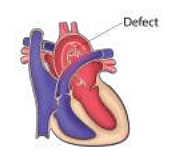
- A defect in which of the following aortic arches causes the defect shown in the image?
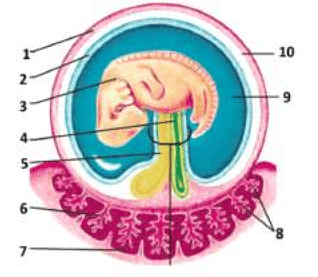
- Which of the following structures develops from the structure marked 4?
View More Questions
Top NEET PG Questions
- A patient hailing from Delhi presents with fever, arthralgia, and extensive petechial rash for 3 days. Lab investigations revealed a hemoglobin of 9 g/ dL, a white blood cell count of 9000 cells/mm3, a platelet count of 20000 cells/mm3, and a prolonged bleeding time. The clotting time was normal. What is the most likely diagnosis?
- Which of the following statements is true about Trichomonas vaginalis?
- A lady from West Rajasthan presented with an ulcer surrounded by erythema on the right leg. Microscopy of the biopsy from the edge of the ulcer showed organisms with dark staining nuclei and kinetoplast. What is the most likely causative agent?
- A child presents with a fever and a rash. Urine examination showed cells with owl's eye appearance. What is the most likely diagnosis?
- Infection with Clonorchis sinensis is associated with an increased risk of__?
View More Questions