Question:
All of the following are associated with polycystic ovarian syndrome, except:
All of the following are associated with polycystic ovarian syndrome, except:
Show Hint
PCOS has unopposed oestrogen, so which listed problem actually needs low oestrogen?
Updated On: Jun 24, 2026
- Ovarian carcinoma
- Endometrial carcinoma
- Insulin resistance
- Osteoporosis
Show Solution

Verified By Collegedunia
The Correct Option is D
Solution and Explanation
Step 1: Recall the core hormonal picture of PCOS. There is chronic anovulation, raised androgens, and a relative excess of unopposed oestrogen because regular progesterone-producing corpora lutea are not formed.
Step 2: Link the hormones to risk. Unopposed oestrogen continuously stimulates the endometrium, raising the risk of endometrial hyperplasia and endometrial carcinoma (B). PCOS is also strongly tied to insulin resistance and hyperinsulinaemia, which drives the metabolic syndrome and worsens the hyperandrogenism (C). There is a modest reported association with ovarian carcinoma as well (A).
Step 3: Test the bone option. Osteoporosis comes from oestrogen deficiency, as in menopause or hypothalamic amenorrhoea. In PCOS oestrogen levels are normal to high, not low, so the bones are not deprived of oestrogen. Hence osteoporosis is not a feature.
Step 4: Conclude. The odd one out is osteoporosis because it requires an oestrogen-deficient state, the opposite of the unopposed-oestrogen environment of PCOS.
Answer: Osteoporosis (Option D).
Step 2: Link the hormones to risk. Unopposed oestrogen continuously stimulates the endometrium, raising the risk of endometrial hyperplasia and endometrial carcinoma (B). PCOS is also strongly tied to insulin resistance and hyperinsulinaemia, which drives the metabolic syndrome and worsens the hyperandrogenism (C). There is a modest reported association with ovarian carcinoma as well (A).
Step 3: Test the bone option. Osteoporosis comes from oestrogen deficiency, as in menopause or hypothalamic amenorrhoea. In PCOS oestrogen levels are normal to high, not low, so the bones are not deprived of oestrogen. Hence osteoporosis is not a feature.
Step 4: Conclude. The odd one out is osteoporosis because it requires an oestrogen-deficient state, the opposite of the unopposed-oestrogen environment of PCOS.
Answer: Osteoporosis (Option D).
Was this answer helpful?
0
0
Top NEET PG Gynaecology and Obstetrics Questions
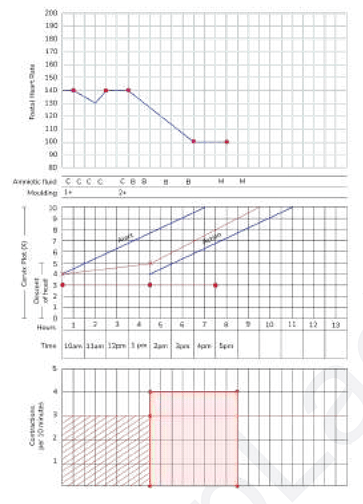
- A partogram of a woman who is in labor is shown below. Oxytocin infusion is already given. How will you manage the condition?
- A woman presents to you at 36 weeks of gestation with complaints of breathlessness and excessive abdominal distension. Fetal movements are normal. On examination, fetal parts are not easily felt and fetal heartbeat is heard but it is muffled. Her symphysis fundal height is 41 cm. Her abdomen is tense but not tender. What is the most likely diagonosis?
- For which of the following procedures in the given OT list, can you preferably do a hysteroscopy ?
- A primigravida presents to you with anemia early in her pregnancy. She is 7 weeks pregnant as seen on ultrasound. Her hemoglobin level is 9 g/dL. When should the iron supplements be started for her?
- A 23-year-old woman accompanied by her mother-in-law comes to the infertility clinic. She has been having regular intercourse for 6 months but is not able to conceive. What is the next best step?
View More Questions
Top NEET PG Questions
- A patient hailing from Delhi presents with fever, arthralgia, and extensive petechial rash for 3 days. Lab investigations revealed a hemoglobin of 9 g/ dL, a white blood cell count of 9000 cells/mm3, a platelet count of 20000 cells/mm3, and a prolonged bleeding time. The clotting time was normal. What is the most likely diagnosis?
- Which of the following statements is true about Trichomonas vaginalis?
- A lady from West Rajasthan presented with an ulcer surrounded by erythema on the right leg. Microscopy of the biopsy from the edge of the ulcer showed organisms with dark staining nuclei and kinetoplast. What is the most likely causative agent?
- A child presents with a fever and a rash. Urine examination showed cells with owl's eye appearance. What is the most likely diagnosis?
- Infection with Clonorchis sinensis is associated with an increased risk of__?
View More Questions