∆ ABC is right angled at A (Fig 9.16). AD is perpendicular to BC. If AB = \(5\) cm, BC = \(13\) cm and AC = \(12\) cm, Find the area of ∆ ABC. Also find the length of AD.


Approach Solution - 1
\(Area= \frac{1}{2}\times Base \times Height\)
\(=\frac{1}{2}\times 5\times 12=30\; cm^2\)
Also, area of triangle = \(\frac{1}{2}\times AD\times BC\)
\(30=\frac{1}{2}\times AD\times 13\)
\(\frac{30\times 2}{13}=AD\)
\(AD=4.6\;cm\)
Approach Solution -2
Given:
AB = 5cm and AC = 12cm
Step 1: Calculate the Area of \(\Delta ABC\)
Since \(\Delta ABC\) is a right-angled triangle at A, we can use the lengths of AB and AC to find the area.
The area of a right-angled triangle is given by:
\(\text{Area} = \frac{1}{2} \times \text{base} \times \text{height}\)
Thus, the area is:
\(\text{Area} = \frac{1}{2} \times 5 \, \text{cm} \times 12 \, \text{cm}\)
\(\text{Area} = \frac{1}{2} \times 60 \, \text{cm}^2\)
\(\text{Area} = 30 \, \text{cm}^2\)
Step 2: Calculate the Length of AD
\(\text{Area} = \frac{1}{2} \times \text{base} \times \text{height}\)
\(30 \, \text{cm}^2 = \frac{1}{2} \times 13 \, \text{cm} \times AD\)
\(30 \, \text{cm}^2 = \frac{13}{2} \times AD\)
\(30 \times 2 = 13 \times AD\)
\(60 = 13 \times AD\)
\(AD = \frac{60}{13}\)
\(AD = 4.62 \, \text{cm}\)
So, the answer is 4.62 cm
Top CBSE Class VII Mathematics Questions
- Find the area of each of the following parallelograms:

- Find the area of each of the following triangles:

- Find the missing values:
So No Base Height Area of parallelogram a. 20 cm - 246 \(cm^2\) b. - 15 cm 154.5 \(cm^2\) c. - 8.4 cm 48.72 \(cm^2\) d. 15.6 cm - 16.38 \(cm^2\) - Find the missing values:
Base Height Area of triangle 15 cm - 87 \(cm^2\) - 31.4 mm 1256 \(mm^2\) 22 cm - 170.5 \(cm^2\) - PQRS is a parallelogram (see the given figure). QM is the height from Q to SR and QN is the height from Q to PS. If SR = \(12\) cm and QM = \(7.6\) cm. Find:
- the area of the parallelogram PQRS
- QN, if PS = 8 cm

Top CBSE Class VII Area of a Triangle Questions
- Find the area of each of the following triangles:
- Find the missing values:
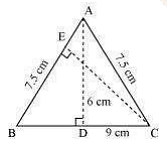
Base Height Area of triangle 15 cm - 87 \(cm^2\) - 31.4 mm 1256 \(mm^2\) 22 cm - 170.5 \(cm^2\) - ∆ABC is isosceles with AB = AC = 7.5 cm and BC = 9 cm (Fig 9.17). The height AD from A to BC, is 6 cm. Find the area of ∆ABC. What will be the height from C to AB i.e., CE?
Top CBSE Class VII Questions
- Find the area of each of the following parallelograms:
- Find the area of each of the following triangles:
- Find the missing values:
So No Base Height Area of parallelogram a. 20 cm - 246 \(cm^2\) b. - 15 cm 154.5 \(cm^2\) c. - 8.4 cm 48.72 \(cm^2\) d. 15.6 cm - 16.38 \(cm^2\) - Find the missing values:
Base Height Area of triangle 15 cm - 87 \(cm^2\) - 31.4 mm 1256 \(mm^2\) 22 cm - 170.5 \(cm^2\) - PQRS is a parallelogram (see the given figure). QM is the height from Q to SR and QN is the height from Q to PS. If SR = \(12\) cm and QM = \(7.6\) cm. Find:
- the area of the parallelogram PQRS
- QN, if PS = 8 cm