Question:
A patient presents with fever and abdominal pain. Clinical examination reveals hepatomegaly extending 4 finger-breadths below the costal margin. USG and CT reveal a 4 cm x 5 cm x 4 cm hypoechoic and hypodense lesion 1 cm deep to the liver surface. Tests for hydatid disease are negative. The best course of action is?
A patient presents with fever and abdominal pain. Clinical examination reveals hepatomegaly extending 4 finger-breadths below the costal margin. USG and CT reveal a 4 cm x 5 cm x 4 cm hypoechoic and hypodense lesion 1 cm deep to the liver surface. Tests for hydatid disease are negative. The best course of action is?
Show Hint
Hydatid-negative solitary liver abscess is amoebic; uncomplicated ones melt away on drugs alone.
Updated On: Jun 24, 2026
- Resection of the affected lobe
- Multiple percutaneous aspirations and metronidazole injection in the right lobe
- Metronidazole therapy only
- Surgical drainage of the abscess and metronidazole therapy
Show Solution

Verified By Collegedunia
The Correct Option is C
Solution and Explanation
Step 1: Identify the diagnosis. Fever, abdominal pain, tender hepatomegaly and a solitary hypoechoic/hypodense liver lesion, with hydatid serology negative, points to an amoebic liver abscess. This is the commonest cause of a solitary liver abscess in endemic areas.
Step 2: Recall the principle of treatment. Uncomplicated amoebic liver abscess responds dramatically to medical therapy alone; metronidazole is the drug of choice (followed by a luminal amoebicide such as diloxanide furoate to clear intestinal carriage). Most abscesses resolve on drug therapy without any drainage.
Step 3: Decide whether drainage is needed. Drainage (preferably percutaneous aspiration, not open surgery) is reserved for specific indications: no clinical response after 48 to 72 hours of metronidazole, a large abscess (commonly quoted > 5 to 6 cm or in the left lobe with risk of pericardial rupture), threatened or impending rupture, or diagnostic uncertainty. This 4 x 5 x 4 cm lesion is uncomplicated and not threatening rupture, so it does not yet meet drainage criteria.
Step 4: Eliminate the wrong options. Lobar resection is far too aggressive for an abscess. Open surgical drainage is rarely needed and is reserved for rupture or failed aspiration. Repeated percutaneous aspiration is a second-line measure if medical therapy fails. The appropriate initial step here is metronidazole therapy alone.
Answer: C (Metronidazole therapy only).
Step 2: Recall the principle of treatment. Uncomplicated amoebic liver abscess responds dramatically to medical therapy alone; metronidazole is the drug of choice (followed by a luminal amoebicide such as diloxanide furoate to clear intestinal carriage). Most abscesses resolve on drug therapy without any drainage.
Step 3: Decide whether drainage is needed. Drainage (preferably percutaneous aspiration, not open surgery) is reserved for specific indications: no clinical response after 48 to 72 hours of metronidazole, a large abscess (commonly quoted > 5 to 6 cm or in the left lobe with risk of pericardial rupture), threatened or impending rupture, or diagnostic uncertainty. This 4 x 5 x 4 cm lesion is uncomplicated and not threatening rupture, so it does not yet meet drainage criteria.
Step 4: Eliminate the wrong options. Lobar resection is far too aggressive for an abscess. Open surgical drainage is rarely needed and is reserved for rupture or failed aspiration. Repeated percutaneous aspiration is a second-line measure if medical therapy fails. The appropriate initial step here is metronidazole therapy alone.
Answer: C (Metronidazole therapy only).
Was this answer helpful?
0
0
Top NEET PG Surgery Questions
- A 55-year-old male presented with verrucous carcinoma around the glans of the penis. Examination reveals that the inguinal lymph nodes are not enlarged. What is the appropriate management for this patient?
- Identify the procedure being performed in the image given below.
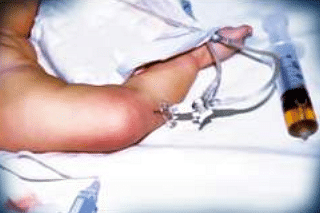
- A diabetic patient presents with sudden-onset perineal pain. On examination, foul-smelling discharge, and necrotic tissue as seen in the image is noted. Which of the following is true about the given condition?
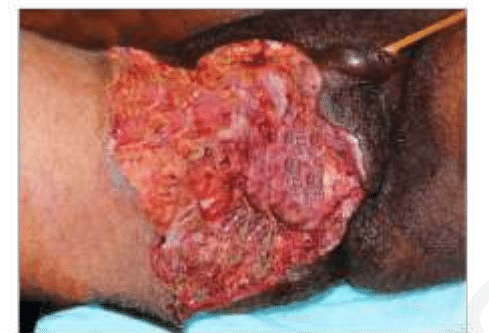
- Which of the following is the most common complication following ligation of the first vessel during abdominoperineal resection for rectal carcinoma?(APR Abdominoperineal resection)
- A patient presents to the clinic with the lesion given in the image. He had a traumatic injury to the chest one year ago. What is the most likely diagnosis?
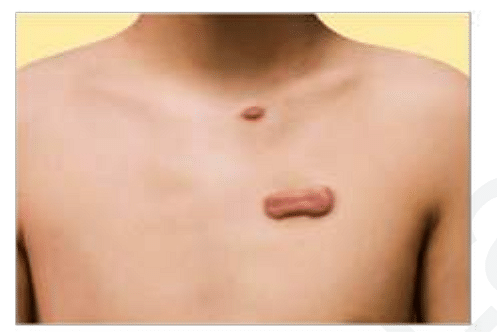
View More Questions
Top NEET PG Amoebic liver abscess Questions
Top NEET PG Questions
- A patient hailing from Delhi presents with fever, arthralgia, and extensive petechial rash for 3 days. Lab investigations revealed a hemoglobin of 9 g/ dL, a white blood cell count of 9000 cells/mm3, a platelet count of 20000 cells/mm3, and a prolonged bleeding time. The clotting time was normal. What is the most likely diagnosis?
- Which of the following statements is true about Trichomonas vaginalis?
- A lady from West Rajasthan presented with an ulcer surrounded by erythema on the right leg. Microscopy of the biopsy from the edge of the ulcer showed organisms with dark staining nuclei and kinetoplast. What is the most likely causative agent?
- A child presents with a fever and a rash. Urine examination showed cells with owl's eye appearance. What is the most likely diagnosis?
- Infection with Clonorchis sinensis is associated with an increased risk of__?
View More Questions