A bubble has surface tension $S$. The ideal gas inside the bubble has ratio of specific heats $\gamma=\frac{5}{3}$. The bubble is exposed to the atmosphere and it always retains its spherical shape. When the atmospheric pressure is $P_{a 1}$, the radius of the bubble is found to be $r_1$ and the temperature of the enclosed gas is $T_1$. When the atmospheric pressure is $P_{a 2}$, the radius of the bubble and the temperature of the enclosed gas are $r_2$ and $T_2$, respectively.Which of the following statement(s) is(are) correct?
- If the surface of the bubble is a perfect heat insulator, then $\left(\frac{r_1}{r_2}\right)^5=\frac{P_{a 2}+\frac{2 S}{r_2}}{P_{a 1}+\frac{2 S}{r_1}}$
- If the surface of the bubble is a perfect heat insulator, then the total internal energy of the bubble including its surface energy does not change with the external atmospheric pressure.
- If the surface of the bubble is a perfect heat conductor and the change in atmospheric temperature is negligible, then $\left(\frac{r_1}{r_2}\right)^3=\frac{P_{a 2}+\frac{4 S}{r_2}}{P_{a 1}+\frac{4 S}{r_1}}$.
- If the surface of the bubble is a perfect heat insulator, then $\left(\frac{T_2}{T_1}\right)^{\frac{5}{2}}=\frac{P_{a 2}+\frac{4 S}{r_2}}{P_{a 1}+\frac{4 S}{r_1}}$.

The Correct Option is C, D
Solution and Explanation
The correct answers are:
(C) If the surface of the bubble is a perfect heat conductor and the change in atmospheric temperature is negligible, then $\left(\frac{r_1}{r_2}\right)^3=\frac{P_{a 2}+\frac{4 S}{r_2}}{P_{a 1}+\frac{4 S}{r_1}}$.
(D) If the surface of the bubble is a perfect heat insulator, then $\left(\frac{T_2}{T_1}\right)^{\frac{5}{2}}=\frac{P_{a 2}+\frac{4 S}{r_2}}{P_{a 1}+\frac{4 S}{r_1}}$.
Top JEE Advanced Physics Questions
- A projectile of mass 200 g is launched in a viscous medium at an angle $60^\circ$ with the horizontal, with an initial velocity of 270 m/s. It experiences a viscous drag force $\vec{F} = -c \vec{v}$ where the drag coefficient $c = 0.1 \, \text{kg/s}$ and $\vec{v}$ is the instantaneous velocity of the projectile. The projectile hits a vertical wall after 2 s. Taking $e = 2.7$, the horizontal distance of the wall from the point of projection (in m) is ____
- JEE Advanced - 2025
- Physics
- Projectile motion
The left and right compartments of a thermally isolated container of length $L$ are separated by a thermally conducting, movable piston of area $A$. The left and right compartments are filled with $\frac{3}{2}$ and 1 moles of an ideal gas, respectively. In the left compartment the piston is attached by a spring with spring constant $k$ and natural length $\frac{2L}{5}$. In thermodynamic equilibrium, the piston is at a distance $\frac{L}{2}$ from the left and right edges of the container as shown in the figure. Under the above conditions, if the pressure in the right compartment is $P = \frac{kL}{A} \alpha$, then the value of $\alpha$ is ____

- JEE Advanced - 2025
- Physics
- Thermodynamics
- An audio transmitter (T) and a receiver (R) are hung vertically from two identical massless strings of length 8 m with their pivots well separated along the $X$ axis. They are pulled from the equilibrium position in opposite directions along the $X$ axis by a small angular amplitude $\theta_0 = \cos^{-1}(0.9)$ and released simultaneously. If the natural frequency of the transmitter is 660 Hz and the speed of sound in air is 330 m/s, the maximum variation in the frequency (in Hz) as measured by the receiver (Take the acceleration due to gravity $g = 10\, \text{m/s}^2$) is ___
- JEE Advanced - 2025
- Physics
- Waves and Oscillations
A temperature difference can generate e.m.f. in some materials. Let $ S $ be the e.m.f. produced per unit temperature difference between the ends of a wire, $ \sigma $ the electrical conductivity and $ \kappa $ the thermal conductivity of the material of the wire. Taking $ M, L, T, I $ and $ K $ as dimensions of mass, length, time, current and temperature, respectively, the dimensional formula of the quantity $ Z = \frac{S^2 \sigma}{\kappa} $ is:
- JEE Advanced - 2025
- Physics
- Dimensional Analysis
- The efficiency of a Carnot engine operating with a hot reservoir kept at a temperature of 1000 K is 0.4. It extracts 150 J of heat per cycle from the hot reservoir. The work extracted from this engine is being fully used to run a heat pump which has a coefficient of performance 10. The hot reservoir of the heat pump is at a temperature of 300 K. Which of the following statements is/are correct:
- JEE Advanced - 2025
- Physics
- Thermodynamics
Top JEE Advanced mechanical properties of fluid Questions
- An incompressible liquid is filled in a container. There is air above the liquid and a massless movable piston with a hole is also placed on the air. A thin capillary tube of inner radius 0.1 mm is dipped vertically into the liquid through the hole on the piston as shown in the figure. The air in the container is isothermally compressed from the original volume V0 to \(\frac{100}{101}\)V0 with the movable piston. Considering air as an ideal gas, the height (h) of the liquid column in the capillary above the liquid level in cm is:

(given Twater =0.075N/m, P0=105N/m2 , g=10m/sec2, \(\rho l\)=103 kg/m3, \(\theta=0\))- JEE Advanced - 2023
- Physics
- mechanical properties of fluid
- An incompressible liquid is filled in a container. There is air above the liquid and a massless movable piston with a hole is also placed on the air. A thin capillary tube of inner radius 0.1 mm is dipped vertically into the liquid through the hole on the piston as shown in the figure. The air in the container is isothermally compressed from the original volume V0 to \(\frac{100}{101}\)V0 with the movable piston. Considering air as an ideal gas, the height (h) of the liquid column in the capillary above the liquid level in cm is:
(given Twater =0.075N/m, P0=105N/m2 , g=10m/sec2, \(\rho l\)=103 kg/m3, \(\theta=0\))- JEE Advanced - 2023
- Physics
- mechanical properties of fluid
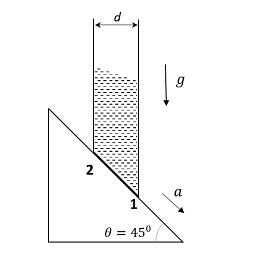
- A cylindrical tube, with its base as shown in the figure, is filled with water It is moving down with a constant acceleration $a$ along a fixed inclined plane with angle $\theta=45^{\circ} P_{1}$ and $P_{2}$ are pressures at points $1$ and $2$, respectively located at the base of the tube. Let $\beta=\left(P_{1}-P_{2}\right) /(\rho g d)$, where $\rho$ is density of water, $d$ is the inner diameter of the tube and $g$ is the acceleration due to gravity. Which of the following statement(s) is(are) correct?
- JEE Advanced - 2021
- Physics
- mechanical properties of fluid
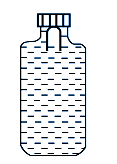
- A Soft plastic bottle, filled with water of density $1\, gm / cc$, carries an inverted glass test-tube with some air (ideal gas) trapped as shown in the figure The test-tube has a mass of $5\, gm$, and it is made of a thick glass of density $25 \,gm / cc$ Initially the bottle is sealed at atmospheric pressure $p _{0}=10^{5} \,Pa$ so that the volume of the trapped air is $v _{0}=33\, cc$ When the bottle is squeezed from outside at constant temperature, the pressure inside rises and the volume of the trapped air reduces It is found that the test tube begins to sink at pressure $p _{0}+\Delta p$ without changing its orientation At this pressure, the volume of the trapped air is $v _{0}-\Delta v$ Let $\Delta v = X \,\,cc$ and $\Delta p = Y \times 10^{3} Pa$ The value of $X$ is _______
- JEE Advanced - 2021
- Physics
- mechanical properties of fluid
A soft plastic bottle, filled with water of density 1 gm/cc, carries an inverted glass test tube with some air (ideal gas) trapped as shown in the figure. The test tube has a mass of 5 gm, and it is made of a thick glass of density 2.5 gm/cc. Initially, the bottle is sealed at atmospheric pressure p0 = 105 Pa so that the volume of the trapped air is V0 = 3.3 cc. When the bottle is squeezed from outside at a constant temperature, the pressure inside rises and the volume of the trapped air reduces. It is found that the test tube begins to sink at pressure p0 + Δp without changing its orientation. At this pressure, the volume of the trapped air is V0 – ΔV.
Let ΔV = X cc and Δp = Y × 103 Pa.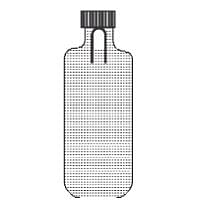
- JEE Advanced - 2021
- Physics
- mechanical properties of fluid
Top JEE Advanced Questions
- Let $ x_0 $ be the real number such that $ e^{x_0} + x_0 = 0 $. For a given real number $ \alpha $, define $$ g(x) = \frac{3xe^x + 3x - \alpha e^x - \alpha x}{3(e^x + 1)} $$ for all real numbers $ x $. Then which one of the following statements is TRUE?
- JEE Advanced - 2025
- Fundamental Theorem of Calculus
- A linear octasaccharide (molar mass = 1024 g mol$^{-1}$) on complete hydrolysis produces three monosaccharides: ribose, 2-deoxyribose and glucose. The amount of 2-deoxyribose formed is 58.26 % (w/w) of the total amount of the monosaccharides produced in the hydrolyzed products. The number of ribose unit(s) present in one molecule of octasaccharide is _____.
Use: Molar mass (in g mol$^{-1}$): ribose = 150, 2-deoxyribose = 134, glucose = 180; Atomic mass (in amu): H = 1, O = 16- JEE Advanced - 2025
- Biomolecules
Let $ P(x_1, y_1) $ and $ Q(x_2, y_2) $ be two distinct points on the ellipse $$ \frac{x^2}{9} + \frac{y^2}{4} = 1 $$ such that $ y_1 > 0 $, and $ y_2 > 0 $. Let $ C $ denote the circle $ x^2 + y^2 = 9 $, and $ M $ be the point $ (3, 0) $. Suppose the line $ x = x_1 $ intersects $ C $ at $ R $, and the line $ x = x_2 $ intersects $ C $ at $ S $, such that the $ y $-coordinates of $ R $ and $ S $ are positive. Let $ \angle ROM = \frac{\pi}{6} $ and $ \angle SOM = \frac{\pi}{3} $, where $ O $ denotes the origin $ (0, 0) $. Let $ |XY| $ denote the length of the line segment $ XY $. Then which of the following statements is (are) TRUE?
- JEE Advanced - 2025
- Conic sections
- Adsorption of phenol from its aqueous solution on to fly ash obeys Freundlich isotherm. At a given temperature, from 10 mg g$^{-1}$ and 16 mg g$^{-1}$ aqueous phenol solutions, the concentrations of adsorbed phenol are measured to be 4 mg g$^{-1}$ and 10 mg g$^{-1}$, respectively. At this temperature, the concentration (in mg g$^{-1}$) of adsorbed phenol from 20 mg g$^{-1}$ aqueous solution of phenol will be ____. Use: $\log_{10} 2 = 0.3$
- JEE Advanced - 2025
- Adsorption
- At 300 K, an ideal dilute solution of a macromolecule exerts osmotic pressure that is expressed in terms of the height (h) of the solution (density = 1.00 g cm$^{-3}$) where h is equal to 2.00 cm. If the concentration of the dilute solution of the macromolecule is 2.00 g dm$^{-3}$, the molar mass of the macromolecule is calculated to be $X \times 10^{4}$ g mol$^{-1}$. The value of $X$ is ____. Use: Universal gas constant (R) = 8.3 J K$^{-1}$ mol$^{-1}$ and acceleration due to gravity (g) = 10 m s$^{-2}\}$
- JEE Advanced - 2025
- Colligative Properties
Concepts Used:
Mechanical Properties of Fluid
The science of the mechanical properties of fluids is called Hydrostatics. A fluid is a substance that relents to the slightest pressure. Fluids are categorized into two classes famed by the names of liquids, and elastic fluids or gases, which later comprehend the air of the atmosphere and all the different kinds of air with which chemistry makes us acquainted.
Streamline Flow:
A streamline is a curve the tangent to which at any point provides the direction of the fluid velocity at that point. It is comparable to a line of force in an electric or magnetic field. In steady flow, the pattern of the streamline is motionless or static with time, and therefore, a streamline provides the actual path of a fluid particle.
Tube of Flow:
A tubular region of fluid enclosed by a boundary comprises streamlines is called a tube of flow. Fluid can never cross the boundaries of a tube of flow and therefore, a tube of flow acts as a pipe of the same shape.
Surface Tension and Viscosity:
The surface tension of a liquid is all the time a function of the solid or fluid with which the liquid is in contact. If a value for surface tension is provided in a table for oil, water, mercury, or whatever, and the contacting fluid is unspecified, it is safe to consider that the contacting fluid is air.