Question:
A 40 year old male patient is brought to the emergency room with a stab injury to the chest. On examination the patient is found to be hemodynamically stable. The neck veins are engorged and the heart sounds are muffled. All the following statements are true about this patient except:
A 40 year old male patient is brought to the emergency room with a stab injury to the chest. On examination the patient is found to be hemodynamically stable. The neck veins are engorged and the heart sounds are muffled. All the following statements are true about this patient except:
Show Hint
Beck's triad points to tamponade, but ER thoracotomy is only for patients without vital signs.
Updated On: Jul 8, 2026
- Cardiac tamponade is likely to be present
- Immediate emergency room thoracotomy should be done
- Echo should be done to confirm pericardial blood
- The entry wound should be sealed with an occlusive dressing
Show Solution

Verified By Collegedunia
The Correct Option is B
Solution and Explanation
Step 1: Read the clinical clues.
A stab wound to the chest with engorged neck veins and muffled heart sounds are two parts of Beck's triad (the third part, low blood pressure, may not show up yet since the patient is still called hemodynamically stable here). This combination after penetrating chest trauma points strongly to blood collecting inside the pericardial sac and squeezing the heart, which is cardiac tamponade.
Step 2: Confirm statement 1 is true.
Given the exam findings, cardiac tamponade is indeed likely to be present, so this statement is a correct fact about the patient and is not the exception being asked for.
Step 3: Check the indication for emergency room thoracotomy.
Emergency room thoracotomy, opening the chest right in the resuscitation bay, is a drastic step kept for patients who arrive with no vital signs, who lose their pulse in front of the team, or who arrest from penetrating trauma with recent signs of life. A patient who is still hemodynamically stable, as described here, does not need this. The correct path is to confirm the diagnosis and take the patient to the operating room in a controlled way. So the claim that immediate ER thoracotomy should be done is false for this stable patient.
Step 4: Confirm statement 3 is true.
Bedside echocardiography, or a FAST scan, is the fast, safe way to look for fluid around the heart and confirm pericardial blood before deciding on pericardiocentesis or surgery. This is correct management.
Step 5: Confirm statement 4 is true.
Covering the entry wound with an occlusive, airtight dressing is a standard first aid step for a chest wound, done to limit air entering the chest while the patient is worked up further. This statement also holds true.
Step 6: Final Answer.
The one statement that does not hold true is the claim that immediate emergency room thoracotomy should be done, since that step is kept for patients without vital signs, not a stable one.
\[ \boxed{\text{Immediate emergency room thoracotomy should be done}} \]
A stab wound to the chest with engorged neck veins and muffled heart sounds are two parts of Beck's triad (the third part, low blood pressure, may not show up yet since the patient is still called hemodynamically stable here). This combination after penetrating chest trauma points strongly to blood collecting inside the pericardial sac and squeezing the heart, which is cardiac tamponade.
Step 2: Confirm statement 1 is true.
Given the exam findings, cardiac tamponade is indeed likely to be present, so this statement is a correct fact about the patient and is not the exception being asked for.
Step 3: Check the indication for emergency room thoracotomy.
Emergency room thoracotomy, opening the chest right in the resuscitation bay, is a drastic step kept for patients who arrive with no vital signs, who lose their pulse in front of the team, or who arrest from penetrating trauma with recent signs of life. A patient who is still hemodynamically stable, as described here, does not need this. The correct path is to confirm the diagnosis and take the patient to the operating room in a controlled way. So the claim that immediate ER thoracotomy should be done is false for this stable patient.
Step 4: Confirm statement 3 is true.
Bedside echocardiography, or a FAST scan, is the fast, safe way to look for fluid around the heart and confirm pericardial blood before deciding on pericardiocentesis or surgery. This is correct management.
Step 5: Confirm statement 4 is true.
Covering the entry wound with an occlusive, airtight dressing is a standard first aid step for a chest wound, done to limit air entering the chest while the patient is worked up further. This statement also holds true.
Step 6: Final Answer.
The one statement that does not hold true is the claim that immediate emergency room thoracotomy should be done, since that step is kept for patients without vital signs, not a stable one.
\[ \boxed{\text{Immediate emergency room thoracotomy should be done}} \]
Was this answer helpful?
0
0
Top NEET PG Surgery Questions
- A 55-year-old male presented with verrucous carcinoma around the glans of the penis. Examination reveals that the inguinal lymph nodes are not enlarged. What is the appropriate management for this patient?
- Identify the procedure being performed in the image given below.
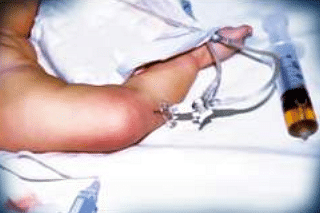
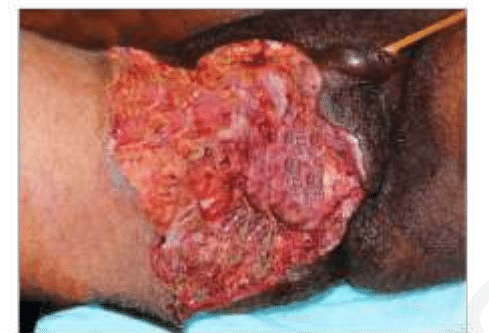
- A diabetic patient presents with sudden-onset perineal pain. On examination, foul-smelling discharge, and necrotic tissue as seen in the image is noted. Which of the following is true about the given condition?
- Which of the following is the most common complication following ligation of the first vessel during abdominoperineal resection for rectal carcinoma?(APR Abdominoperineal resection)
- A patient presents to the clinic with the lesion given in the image. He had a traumatic injury to the chest one year ago. What is the most likely diagnosis?
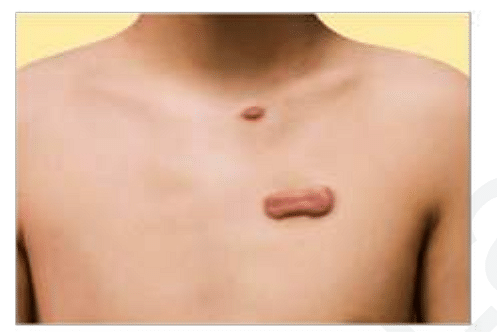
View More Questions
Top NEET PG Penetrating chest trauma and cardiac tamponade Questions
Top NEET PG Questions
- A patient hailing from Delhi presents with fever, arthralgia, and extensive petechial rash for 3 days. Lab investigations revealed a hemoglobin of 9 g/ dL, a white blood cell count of 9000 cells/mm3, a platelet count of 20000 cells/mm3, and a prolonged bleeding time. The clotting time was normal. What is the most likely diagnosis?
- Which of the following statements is true about Trichomonas vaginalis?
- A lady from West Rajasthan presented with an ulcer surrounded by erythema on the right leg. Microscopy of the biopsy from the edge of the ulcer showed organisms with dark staining nuclei and kinetoplast. What is the most likely causative agent?
- A child presents with a fever and a rash. Urine examination showed cells with owl's eye appearance. What is the most likely diagnosis?
- Infection with Clonorchis sinensis is associated with an increased risk of__?
View More Questions