



Study Abroad Expert | Updated On - Oct 29, 2026
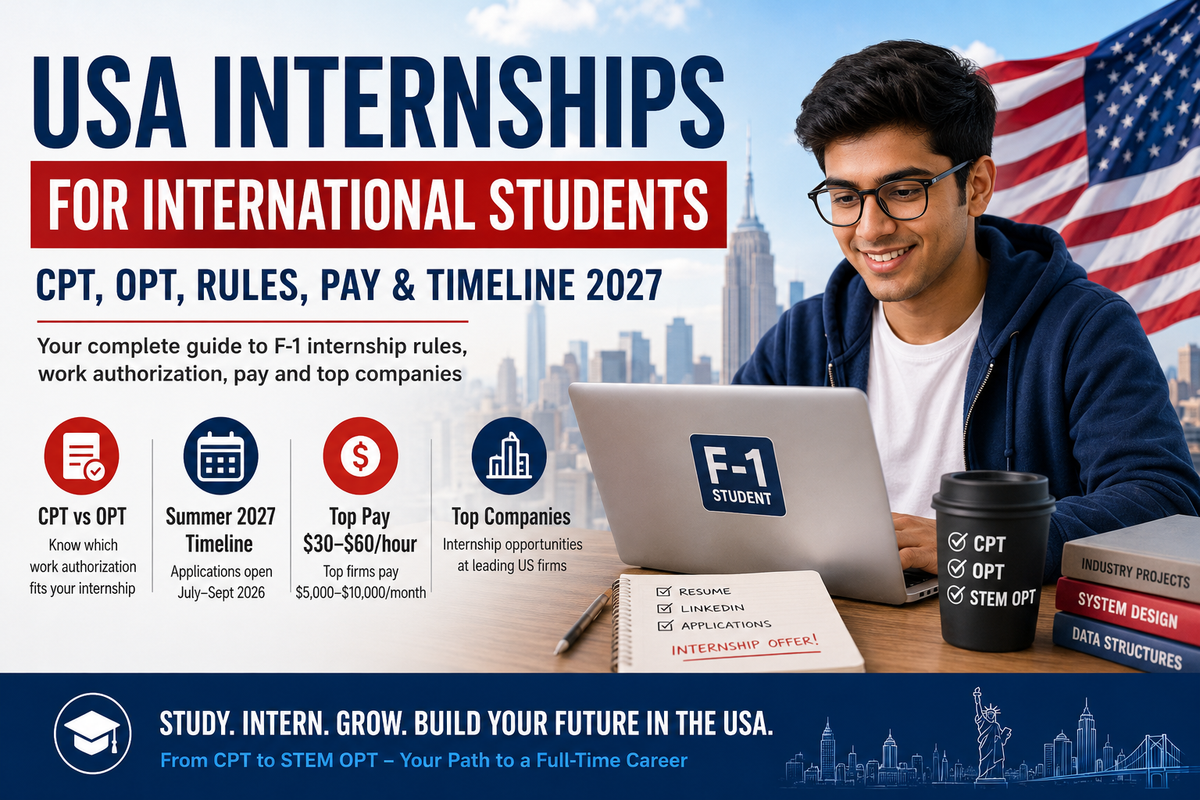
Internships for international students in the USA need CPT or OPT work authorization under F-1 status. Skip the paperwork and your student visa is at risk. Summer 2027 roles open from July 2026 at top companies, with peak hiring in September and October 2026.
- CPT is for internships during your course, so your university approves it before any work starts.
- OPT fits better for internships right after graduation or during a final-semester gap.
- Unpaid roles still count as work, so you need authorization even without a paycheck.
- Apply early, because top tech and finance firms close rolling applications fast.
Check how STEM OPT extends F-1 work rights to 36 months
Advisor commentary flags a common Indian-student gap: resumes buried in jargon that US recruiters cannot scan. Translating project impact into users served or latency reduced gets more callbacks. An internship on your F-1 is the clearest path to a return offer, STEM OPT and a sponsored H-1B later.
Quick Facts on USA Internships
| Parameter | Detail |
|---|---|
| Visa needed | F-1 student visa |
| Work authorization types | CPT (during course) or OPT (post-course, 12 months) |
| STEM OPT extension | 24 extra months, 36 months total |
| CPT eligibility | After one full academic year (two semesters) |
| Max hours during term | 20 hours per week off-campus |
| Max hours during breaks | 40 hours per week (full-time) |
| Summer 2027 hiring opens | July to September 2026 (big tech, banks) |
| Peak application window | September to October 2026 |
| Top tech hourly pay | $30 to $60 per hour (INR 2,900 to INR 5,800) |
| Monthly pay at top firms | $5,000 to $10,000 (INR 4.8 lakh to INR 9.7 lakh) |
Source: USCIS CPT and OPT guidance; Levels.fyi intern pay data; Simplify Summer 2027 timeline.
- F-1 Internship Rules for International Students
- CPT Rules Every Indian Student Must Know
- OPT and STEM OPT for Internships
- Internship Pay Bands in the USA
- Summer 2027 Internship Application Timeline
- Top USA Companies Hiring International Interns
- How to Find Internships in the USA
- Unpaid Internships and Volunteer Rules
- Common Internship Mistakes Indian Students Make
F-1 Internship Rules for International Students
Every internship for international students in the USA runs on F-1 work authorization, not the visa itself.
The F-1 visa lets you study full time in the USA. It does not auto-approve work. For any paid or unpaid role off campus, you need CPT or OPT first.
USCIS treats internships as employment even when the pay is zero. If the employer asks for an I-9 form (US work verification), the role needs CPT or OPT authorization. Working without it can end your student status.
Three employment windows exist on F-1:
- On-campus jobs: allowed from day one, capped at 20 hours per week during term.
- CPT (Curricular Practical Training): off-campus internships tied to your course curriculum.
- OPT (Optional Practical Training): off-campus work during or after your course, 12 months each.
Your university’s Designated School Official (DSO, the staff member who manages F-1 records) authorizes CPT and endorses your updated I-20 form before you join an internship. OPT needs a separate USCIS approval through Form I-765.
Key Insight: On-campus research assistantships and teaching roles do not count as internships. They sit under a separate on-campus work rule and need no CPT.
SEVP (the US agency that tracks F-1 students) logs every work authorization. Any gap or unauthorized role shows up on your record. Read the full SEVP guide for Indian students before signing any offer letter.
Source: USCIS Study in the States, SEVP policy guidance.
CPT Rules Every Indian Student Must Know
CPT is the main route for internships during your masters or bachelors in the USA. It needs an internship course credit, not just an offer letter.
Eligibility is strict and non-negotiable:
- You must be in valid F-1 status.
- You must have completed two full-time semesters (fall and spring) before your CPT start date.
- The internship role must directly match your major.
- You must register for an internship-linked course that semester.
Your DSO issues a new I-20 that lists the employer name, work address and exact dates. The employer cannot start you a day before that I-20 is signed. The F-1 and J-1 visa process guide breaks down the full documentation chain.
CPT comes in two forms:
- Part-time CPT: up to 20 hours per week during the academic term.
- Full-time CPT: up to 40 hours per week, usually during summer or winter breaks.
If X is a full-time CPT stretch longer than 12 months, then Y is a complete loss of OPT eligibility. That means Z: you cannot work after graduation at all. Track your cumulative full-time CPT in months, not semesters.
Final-semester students get one exception. They can take CPT even when enrolled in fewer than full-time credits, as long as the internship course is their last requirement.
Source: USCIS Policy Manual; University DSO offices.
Read More: reasons for F-1 student visa rejection in the USA
OPT and STEM OPT for Internships
OPT suits internships at the end of your degree or during your final summer gap. It gives 12 months of work at any F-1-friendly employer.
OPT splits into two timings:
- Pre-completion OPT: used before graduation, usually during summer. Counts against your 12-month total.
- Post-completion OPT: starts after your degree ends. Full-time work allowed for 12 months.
STEM OPT adds 24 more months on top for students in approved STEM fields. The full stack reaches 36 months of US work rights on one F-1. STEM OPT needs an E-Verify employer (one that checks work status through a federal system) and a signed training plan.
Internships count under OPT the same way full-time jobs do. A paid summer stint at Amazon on pre-completion OPT burns through the same month-bucket as a post-graduation role. Most Indian students save OPT for post-completion, then use CPT for every summer internship.
Unemployment rules are strict:
- Standard OPT: 90 days of unemployment allowed.
- STEM OPT: 60 extra days, totaling 150 unemployment days across 36 months.
Key Insight: OPT internships pay the student directly through a US payroll. Any role routed through an Indian parent company’s HR fails OPT compliance. Confirm the US entity before you sign.
USCIS turnaround for OPT approval runs 90 to 150 days in 2026. File Form I-765 at least four months before you want to start. On-campus work and part-time jobs in the USA can bridge the OPT processing wait.
Source: USCIS Optional Practical Training policy; University of Florida ISS guidance.
Internship Pay Bands in the USA
Internships for international students in the USA pay market rates, with top tech firms clearing $8,000 per month (INR 7.7 lakh). Pay varies sharply by industry and company tier. Levels.fyi tracks real intern offers from student submissions:
| Role tier | Hourly rate (USD) | Monthly pay (INR) |
|---|---|---|
| Top tech (Google, Meta, Amazon) | $45 to $60 | INR 7 lakh to INR 9.7 lakh |
| Mid-tier tech, large banks | $30 to $45 | INR 4.6 lakh to INR 7 lakh |
| Startups, Big 4 consulting | $25 to $35 | INR 3.8 lakh to INR 5.4 lakh |
| Non-tech, non-profits | $15 to $22 | INR 2.3 lakh to INR 3.4 lakh |
| Quant trading (Jump, HRT) | $80 to $120 | INR 12 lakh to INR 18 lakh |
A 12-week summer internship at a top tech firm often pays INR 20 lakh or more. That covers one full semester of US tuition in many public universities. Housing in internship cities adds up fast. Mountain View, San Francisco, New York and Seattle run from $2,500 to $4,000 per month for a shared apartment.
Many top programs include housing stipends or corporate housing. Google interns get a monthly housing allowance. Meta hands out furnished apartments in Menlo Park. Confirm the full package during the offer stage. Pick an internship city based on both pay and daily spend. The best student cities in the USA rank each metro on affordability.
Source: Levels.fyi internship compensation; US Bureau of Labor Statistics.
Summer 2027 Internship Application Timeline
Big tech and investment banks open Summer 2027 internship applications between July and September 2026. Peak hiring runs through October 2026. Most roles use rolling admissions (applications read as they arrive, not after a deadline). Apply in the first week a listing goes live, not the last.
| Window | What happens |
|---|---|
| Jul to Sep 2026 | Big tech and banks open: Google, Meta, Microsoft, Goldman Sachs, JP Morgan |
| Sep to Oct 2026 | Peak season: Amazon, Apple, Big 4, most Fortune 500 programs |
| Nov to Dec 2026 | First-round screens and online assessments |
| Jan to Feb 2027 | Final rounds, Superdays, case finals, virtual on-sites |
| Feb to Mar 2027 | Offers roll out, consulting and tech first |
| May to Jun 2027 | Internship start, CPT I-20 must be in hand |
Consulting opens roughly September to October 2026 for Summer 2027. Law internships (vacation schemes) run on a different cycle, posting from January 2027. Non-profit and government internships post in winter and spring.
If X is a Summer 2027 internship at a top-10 tech firm, then Y is a first-round interview by December 2026. That means Z: you need a polished resume, two to three referrals and a clear idea of your Fall or Spring intake timing before August 2026. Finance moves fastest. Goldman Sachs and JP Morgan filled over 60% of their summer analyst slots in the first application wave in recent cycles.
What students actually say on advisor forums: "Many Indian resumes bury impact in jargon. Convert metrics to global terms, users served, latency reduced or revenue protected."
Build a two-page US-style resume by June 2026. One page for freshers works too. Avoid full paragraphs; use crisp bullets with numbers.
Source: Simplify Summer 2027 timeline; employer career pages.
Top USA Companies Hiring International Interns
Amazon leads CPT and OPT hiring with over 3,000 F-1 interns a year, followed by Microsoft, Tesla and NVIDIA. MyVisaJobs tracks CPT and OPT hires at every US employer. The 2024 and 2025 rankings show a clear top tier:
| Company | CPT hires (2024) | Core intern roles |
|---|---|---|
| Amazon | 3,205 | Software engineer, applied scientist, product manager |
| Tesla | 1,118 | Mechanical, electrical, software, autonomy |
| Microsoft | 819 | Software engineer, data science, research |
| NVIDIA | 743 | Deep learning, systems, GPU architecture |
| Meta | 657 | Software engineer, research scientist, data engineer |
| Deloitte | 614 | Consulting, cyber, risk advisory |
| Apple | 600 | Hardware, iOS, machine learning |
Full OPT numbers for 2024 run even higher. Amazon hired 6,679 OPT workers, Google 1,778 and Microsoft 1,496. That makes them the safest bets for a sponsored H-1B after graduation.
Finance and consulting also hire heavily:
- Finance: Goldman Sachs (962 OPT hires), Morgan Stanley, JP Morgan, Citi, Bank of America.
- Consulting: Deloitte, McKinsey, BCG, Bain, EY, PwC, KPMG.
- Retail and operations: Walmart (1,140 OPT hires), Target, Costco.
Intern pipelines convert well. Over 70% of summer interns at top tech firms receive return offers. For Indian students chasing a US career, the summer internship is the single biggest conversion step.
Not every company sponsors interns though. Startups under 50 employees often avoid F-1 paperwork. Confirm sponsorship history before applying. The MBA path is longer but gives access to a different intern pool. Compare the MBA versus MS tracks in the USA if finance or consulting is your target.
Source: MyVisaJobs 2024 CPT and OPT employer rankings.
How to Find Internships in the USA
University career portals and Handshake deliver the highest hit rate for F-1 internships. LinkedIn and company sites fill the rest.
Build a layered search:
- Handshake: every US university career centre uses it. Filter by "visa sponsorship" and "F-1 CPT friendly".
- Interstride: built for international students. Filter jobs by H-1B history and work authorization.
- LinkedIn: set alerts on "intern" + your major. Message alumni from your university first.
- GoinGlobal: free through most US libraries. Lists H-1B sponsors by city.
- Simplify, RippleMatch, WayUp: aggregator sites that pre-filter student-friendly roles.
Career fairs matter more than Indian students expect. The autumn career fair at a top US STEM school hosts over 300 companies. Recruiters pre-screen on the spot and refer promising candidates. Attend every fair your university runs, even if you are a first-semester student.
Networking rules the funnel. A 2024 Handshake study found students who sent at least 10 connection messages received three times more interview invitations. One warm referral beats 50 cold applications.
Key Insight: When a recruiter asks about your visa status, answer plain: "I am on F-1. My university authorizes CPT, and I can start on this date for 40 hours a week." That removes doubt in one line.
Keep your materials tight. A one-page US resume, a 300-word cover letter and two strong letters of recommendation cover 90% of application needs.
Unpaid Internships and Volunteer Rules
Unpaid internships still need CPT or OPT authorization under F-1. Only true volunteering, limited to non-profits, skips this rule.
The US Department of Labor sets a strict volunteer test. To qualify as a volunteer:
- No expectation of pay, now or later.
- Role is at a non-profit, religious or humanitarian organization.
- You do not replace a paid employee.
- You are not doing work you were once paid for.
If any of these fail, the activity is employment under US law. That means CPT or OPT is mandatory even when the paycheck is zero.
Red flags that signal "employment" not "volunteering":
- Employer asks for an I-9 or W-9 form.
- You get a stipend, housing or travel paid.
- Role has set hours, deliverables and a manager.
- Company is a for-profit entity.
What CPT and OPT cover: paid or unpaid internships at any F-1-friendly employer, part-time or full-time, in your major field.
What CPT and OPT do not cover: remote work for Indian employers, side gigs outside your major, freelance consulting through platforms, startup equity-only roles without a proper US payroll.
Common Internship Mistakes Indian Students Make
The biggest internship mistakes for Indian students on F-1 cost time, money or the visa itself.
Watch for these common traps:
- Starting work before I-20 CPT endorsement: even one day early counts as unauthorized employment.
- Burning 12+ months of full-time CPT: this kills OPT eligibility for life on that degree level.
- Taking a role outside your major: a finance intern role on a CS major fails CPT.
- Missing the CPT course registration deadline: no course credit means no CPT approval.
- Interning for an Indian parent company through US entity: payroll must be US-based.
- Ignoring city costs: a $6,000 pay in San Francisco nets less than $5,000 in Dallas.
- Delaying OPT I-765 filing: 90-to-150-day processing can push your start date past 90-day unemployment limits.
Many Indian students assume on-campus RA (research assistant) work is the same as CPT. It is not. On-campus roles need no CPT but cap at 20 hours per week during term. For off-campus industry internships, CPT is mandatory.
Also watch tier-sensitive bias. Recruiters at top tech firms rank MS candidates from the US higher education system by school tier more aggressively than Indian employers do. A tier-3 US school may still beat a tier-1 Indian school for US intern pipelines because of recruiter familiarity.
Key Insight: Budget a 5 to 8% currency buffer when you plan intern earnings. The rupee has weakened against the dollar in each of the last five years.
Also Check:
| Study in USA Overview | TOEFL Exam Guide | GRE Exam Guide |
| GMAT Exam Guide | Duolingo English Test | Fall vs Spring Intake |
Internships for international students in the USA shape every career outcome that follows. The CPT or OPT paperwork feels heavy at first, but each step guards your F-1 status. Apply early for Summer 2027, pick employers with a strong F-1 track record and match the internship to your major so it clears CPT rules. Build the resume, send the referral messages, and treat the summer intern slot as the real conversion step toward a US job offer and sponsored H-1B. Plan the money with a rupee buffer and the paperwork with your DSO on speed dial.
FAQs
Ques. Can international students do internships in the USA?
Ans. Yes. F-1 students can take paid or unpaid internships through CPT during their course or OPT during or after their degree. Every off-campus internship needs work authorization from the university DSO or USCIS first. Unauthorized work ends F-1 status.
Ques. What is the difference between CPT and OPT for F-1 students?
Ans. CPT ties to a course credit during your degree, approved by your DSO. OPT is a 12-month work window during or after graduation, approved by USCIS. CPT needs an internship course, while OPT needs Form I-765 and a $470 filing fee.
Ques. How much do internships pay international students in the USA?
Ans. Top tech firms pay $5,000 to $10,000 per month (around INR 4.8 lakh to INR 9.7 lakh). Mid-tier tech and large banks pay $4,000 to $6,500 per month. Non-tech roles pay less, often $2,500 to $4,000. Quant trading tops the chart at $15,000 or more per month.
Ques. When should Indian students apply for Summer 2027 internships in the USA?
Ans. Start applications in July to September 2026 for Summer 2027. Big tech and banks open first, with peak hiring from September to October 2026. Most firms use rolling admissions, so first-week applicants get the strongest shot at interviews.
Ques. Can international students do unpaid internships in the USA on F-1?
Ans. Yes, but unpaid internships still need CPT or OPT authorization. Only true volunteering at a non-profit skips this rule. If the employer asks for an I-9 form or sets fixed hours, the role counts as employment and needs full F-1 work authorization.
Ques. Which US companies hire the most international interns?
Ans. Amazon leads with over 3,200 CPT hires in 2024, followed by Tesla, Microsoft, NVIDIA, Meta, Deloitte and Apple. For OPT roles, Amazon (6,679), Google (1,778) and Microsoft (1,496) top the list. These employers also sponsor H-1B visas at scale.
Ques. How many hours can F-1 students work during an internship?
Ans. During the academic term, F-1 students can work up to 20 hours per week off-campus on CPT. During summer and winter breaks, full-time work is allowed at 40 hours per week. On-campus jobs also cap at 20 hours during term.
Ques. Do internships help with the H-1B visa later?
Ans. Yes, strongly. Internship return offers at H-1B sponsor employers like Amazon, Google and Microsoft give the clearest path to a sponsored H-1B. Over 70% of top tech summer interns receive return offers. STEM OPT then extends work rights for 36 months while H-1B lottery runs.
Ques. Is CPT better than OPT for internships in the USA?
Ans. CPT works better for internships during your degree because approval is faster, through your DSO, and does not count against post-graduation OPT. OPT fits better for a final summer or post-degree internship. Most Indian students use CPT for every summer, saving OPT for after graduation.
Ques. What happens if I intern without CPT or OPT authorization?
Ans. Unauthorized employment can lead to F-1 status termination. SEVIS flags the gap, your DSO must report it, and the record follows every future US visa application. Even one unpaid internship without CPT counts. Always confirm authorization with your DSO before day one.



Comments