



Study Abroad Expert | Updated On - Jun 6, 2026
You have finished your UK degree. Now comes the part that actually decides your next two or three years applying for the Graduate Route Visa. This is the UK's official post-study work visa that lets you stay back, work, and build your career without needing a job offer or employer sponsorship.
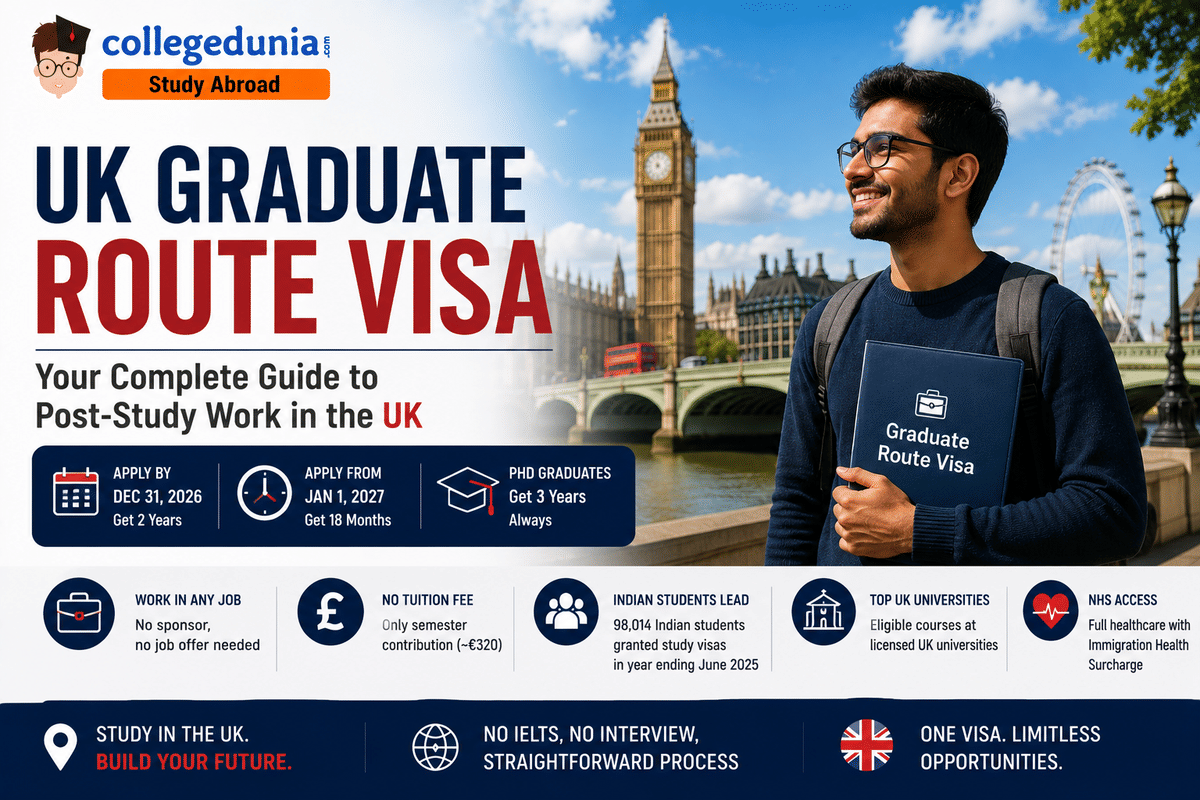
Indian students are the single largest users of this visa. According to UK Home Office data, Indian nationals received 89,231 Graduate Route grants between 2021 and 2023, making up 42% of all grants issued. In the year ending June 2025, 98,014 Indian students were granted UK study visas — nearly all of them eligible for this route after graduation.
There is one critical update you need to know right now. If you apply for the Graduate Route on or before December 31, 2026, you get 2 years to stay and work. If you apply from January 1, 2027, that drops to 18 months for Bachelor's and Master's graduates. PhD graduates continue to get 3 years regardless of when they apply.
This guide walks you through every step of the application — who qualifies, what documents you need, how much it costs, and what to do after you apply.
Conversion Note: All GBP amounts are converted at 1 GBP = ₹126.60 (as of June 5, 2026, source: mtfxgroup.com).
- What Is the Graduate Route Visa and Who Can Apply?
- Which Courses and Universities Qualify for the Graduate Route?
- How Long Does the Graduate Route Visa Last?
- Documents You Need Before You Apply
- Graduate Route Visa Fees: Full Cost Breakdown in GBP and INR
- Step-by-Step: How to Apply for the Graduate Route Visa
- What You Can and Cannot Do on the Graduate Route Visa
- After the Graduate Route: What Comes Next?
- Common Mistakes Indian Students Make — and How to Avoid Them
- Frequently Asked Questions (FAQs)
What Is the Graduate Route Visa and Who Can Apply?
The Graduate Route Visa is a UK post-study work visa introduced in July 2021. It allows international students who have completed an eligible UK degree to stay in the UK and work — in any job, at any salary level — without needing a sponsor.
You do not need a job offer to apply. You do not need to show bank statements. There is no English language test at this stage either. It is one of the most straightforward post-study visas available globally.
To be eligible, all four of the following must be true:
- You are physically present in the UK when you apply
- You hold a valid UK Student Visa or Tier 4 (General) Student Visa
- You have successfully completed an eligible course at a licensed UK university
- Your university has confirmed your course completion to the UK Home Office
You do not need to wait for your graduation ceremony or your degree certificate. As soon as your university reports your completion to the Home Office, you can apply.
Note for Indian Students: You must apply from within the UK. If you travel back to India before applying, you lose your eligibility for the Graduate Route. Do not leave the UK until your Graduate Route visa is approved.
Which Courses and Universities Qualify for the Graduate Route?
Not every course or university automatically qualifies. Your education provider must be a licensed sponsor with a "track record of compliance" on the UKVI register. You can check this on the official UK government sponsor register.
Your course must be one of the following:
- A UK Bachelor's degree
- A UK Master's degree
- A UK PhD or Doctorate
- A law conversion course approved by the Solicitors Regulation Authority
- The Legal Practice Course (England and Wales), Solicitors Course (Northern Ireland), or Diploma in Professional Legal Practice (Scotland)
- The Bar Practice Course (England and Wales) or Bar Course (Northern Ireland)
- A Postgraduate Certificate in Education (PGCE) or Postgraduate Diploma in Education (PGDE)
You also need to have studied in the UK for a minimum period. If your course was longer than 12 months, you must have studied in the UK for at least 12 months. If your course was 12 months or shorter, you must have studied in the UK for the full length of the course.
Note — "Track Record of Compliance": This is a specific UKVI status that a university must hold to be eligible for the Graduate Route. It is different from simply being a licensed student sponsor. When checking the UKVI sponsor register, look for "Student Sponsor – Track Record" in the Status column next to your university's name. If your university does not have this status, you cannot apply for the Graduate Route even if you completed your degree there.
How Long Does the Graduate Route Visa Last?
The duration depends on when you apply and what degree you completed. The table below covers all scenarios clearly.
| Degree Type | Apply on or before Dec 31, 2026 | Apply from Jan 1, 2027 |
|---|---|---|
| Bachelor's Degree | 2 years | 18 months |
| Master's Degree | 2 years | 18 months |
| PhD / Doctorate | 3 years | 3 years (unchanged) |
Your visa starts from the day your application is approved, not from your graduation date. You cannot extend the Graduate Route visa once it is granted. It is a one-time, non-renewable visa.
If you want to stay in the UK beyond the Graduate Route period, you must switch to a different visa — most commonly the Skilled Worker Visa.
Important for Indian Students: The application date determines which rule applies — not your graduation date. A student graduating in September 2026 who applies before December 31, 2026 gets 2 years. A student graduating in January 2027 who applies in January 2027 gets only 18 months. Plan your application timing carefully.
Read More: UK Graduate Route Visa 2026 — What Has Changed and Is It Still Safe for Indian Students
Documents You Need Before You Apply
The Graduate Route application is simpler than the Student Visa in terms of documents. You do not need bank statements or financial proof. Here is what you need to keep ready.
Mandatory documents for all applicants:
- A valid passport or travel document showing your identity and nationality
- Your CAS (Confirmation of Acceptance for Studies) reference number — this is the same number you used when you applied for your Student Visa
- Either your Biometric Residence Permit (BRP) — valid for up to 18 months after the expiry date printed on the card — or online proof of your immigration status if you have an eVisa (you will need to generate a share code)
Additional documents depending on your situation:
- Proof of relationship with your partner or children if they are applying as dependants
- A letter from your scholarship or sponsorship provider approving your application, if they paid for both your course fees and living costs in the last 12 months
Note — CAS Number: Your CAS (Confirmation of Acceptance for Studies) number is a unique reference code your university gave you when they offered you a place on your course. It is not your student ID. If you cannot find it, contact your university's international student office and they will provide it.
If any of your documents are not in English or Welsh, you must provide a certified translation.
Graduate Route Visa Fees: Full Cost Breakdown in GBP and INR
The Graduate Route involves two separate payments — the application fee and the Immigration Health Surcharge (IHS). Both are mandatory. The IHS gives you full access to the UK's National Health Service (NHS) during your stay.
| Fee Component | Amount (GBP) | Amount (INR approx.) | Notes |
|---|---|---|---|
| Graduate Route Application Fee | £937 | ₹1,18,624 | Increased from £822 on April 8, 2026. Non-refundable once processing begins. |
| Immigration Health Surcharge — 18 months | £1,552.50 | ₹1,96,547 | For applications from Jan 1, 2027 (18-month visa) |
| Immigration Health Surcharge — 2 years | £2,070 | ₹2,62,062 | For applications on or before Dec 31, 2026 (2-year visa) |
| Immigration Health Surcharge — 3 years (PhD) | £3,105 | ₹3,93,093 | For PhD graduates (3-year visa) |
| Total Cost — 2-year Graduate Route | £3,007 | ₹3,80,686 | Application fee + 2-year IHS |
| Total Cost — 18-month Graduate Route | £2,489.50 | ₹3,15,171 | Application fee + 18-month IHS (from Jan 2027) |
| Total Cost — 3-year Graduate Route (PhD) | £4,042 | ₹5,11,717 | Application fee + 3-year IHS |
There is no separate biometric fee for most applicants already enrolled in the UKVI system. If you get a job in public sector healthcare after paying the IHS, you may be eligible for a partial refund of the surcharge.
Note — Immigration Health Surcharge (IHS): The IHS is a mandatory payment that gives Graduate Route holders the same access to NHS services as UK residents — including GP visits, hospital treatment, and emergency care. It is calculated at £1,035 per year of your visa duration. For an 18-month visa, it is £1,035 x 1.5 = £1,552.50.
Step-by-Step: How to Apply for the Graduate Route Visa
The entire application is done online from within the UK. There is no paper form. Here is the exact process, step by step.
Step 1 — Confirm Your Course Completion with Your University
Before you apply, check that your university has reported your course completion to the UK Home Office. You do not need your degree certificate. You just need confirmation from your university that they have notified the Home Office. Contact your international student office if you are unsure.
Step 2 — Gather Your Documents
Keep your passport, CAS number, and BRP (or eVisa share code) ready before you start the application. Once you begin, you can save and return to the form — but having everything ready speeds up the process.
Step 3 — Start Your Online Application
Go to the official UK government website at gov.uk/graduate-visa/apply and click "Start now." You will create or sign into your UKVI account. Fill in your personal details, passport information, and CAS reference number.
Step 4 — Pay the Application Fee and IHS
You will be asked to pay the £937 application fee and the Immigration Health Surcharge during the application. The system calculates the IHS amount automatically based on your visa duration. Both payments are made online by card.
Step 5 — Prove Your Identity
You will be told which identity verification method applies to you. There are two options:
- Use the UK Immigration: ID Check app to scan your identity document on your phone — this is the faster option and does not require a centre visit
- Visit a UKVCAS (UK Visa and Citizenship Application Services) service point to have your fingerprints and photo taken — this may be required depending on your passport type
Step 6 — Submit and Wait
Once you have submitted your application, proved your identity, and provided your documents, you will usually get a decision within 8 weeks. You can stay in the UK and continue working on your Student Visa while you wait.
Step 7 — Receive Your eVisa
If your application is approved, you will receive an eVisa — a digital record of your immigration status linked to your UKVI account. You will not receive a physical visa sticker or card. Use the View and Prove service on the UKVI website to generate share codes for employers or landlords.
Critical Rule: Do not travel outside the UK, Ireland, the Channel Islands, or the Isle of Man after submitting your application and before receiving a decision. If you leave, your application will be automatically withdrawn.
What You Can and Cannot Do on the Graduate Route Visa
The Graduate Route gives you broad work rights. There are very few restrictions. Here is a clear breakdown.
| What You CAN Do | What You CANNOT Do |
|---|---|
| Work full-time in most jobs | Work as a professional sportsperson or coach |
| Look for work (you do not need a job to apply) | Apply for most public funds or benefits |
| Be self-employed or freelance | Claim the State Pension |
| Change jobs freely — no limit on job changes | Extend the Graduate Route visa (it cannot be renewed) |
| Work multiple jobs simultaneously | Add new dependants who were not on your Student Visa |
| Travel abroad and return to the UK | Count Graduate Route time toward permanent residency (ILR) |
| Do voluntary work for registered charities or statutory bodies | Study a course eligible for a Student Visa (must apply for Student Visa instead) |
| Bring dependants who were already on your Student Visa |
There is no minimum salary requirement on the Graduate Route itself. You can take any job at any pay level. This is what makes it so valuable for Indian graduates who need time to find a skilled role.
Note for Indian Students — Dependants: From January 2024, most international students on a Student Visa can no longer bring family members to the UK (only PhD and research-based postgraduate students are exempt). At the Graduate Route stage, dependants can only join you if they were already present in the UK as dependants on your Student Visa. No new dependants can be added at this stage.
After the Graduate Route: What Comes Next?
The Graduate Route is a bridge — not a final destination. It gives you time to find a skilled job and switch to a visa that can lead to permanent residency. Here is what your options look like after the Graduate Route.
The most common next step is the Skilled Worker Visa. To switch, you need:
- A job offer from a UKVI-licensed sponsor employer
- A role at RQF Level 6 (graduate-level) or above
- A minimum salary of £41,700 per year (approx. ₹52.8 lakh) — or £33,400 (approx. ₹42.3 lakh) for roles on the Immigration Salary List such as nursing and certain engineering roles
You can switch to the Skilled Worker Visa from within the UK without leaving the country. After 5 years on the Skilled Worker Visa, you become eligible for Indefinite Leave to Remain (ILR) — the UK's version of permanent residency.
The Graduate Route time does not count toward the 5-year ILR qualifying period. Your ILR clock starts only when you switch to the Skilled Worker Visa.
Note for Indian Students — Job Search Reality: According to UK Home Office data, 79% of Indian Graduate Route holders were in employment at some point during the financial year ending 2023. The median annual earnings for Indian Graduate Route holders who worked for the full year was £25,465 (approx. ₹32.2 lakh). The most common sectors were administrative and support services (33% of Indian graduates) and health and social work (14%). Start your job search 6 to 9 months before graduation — not after you receive your visa.
Common Mistakes Indian Students Make — and How to Avoid Them
The Graduate Route application itself is not complicated. But there are a few mistakes that can cost you time, money, or your visa.
- Leaving the UK before applying: This is the most serious mistake. Once you leave, you cannot apply for the Graduate Route. Apply before you travel home.
- Waiting too long after graduation: You must apply before your Student Visa expires. Do not assume you have months to spare — check your visa expiry date and apply as soon as your university confirms completion.
- Not checking if your university has "track record of compliance" status: A licensed sponsor is not the same as a sponsor with track record status. Verify this on the UKVI register before assuming you qualify.
- Travelling during the application: After submitting your application, do not leave the UK, Ireland, the Channel Islands, or the Isle of Man. Your application will be withdrawn automatically if you do.
- Assuming the Graduate Route leads to permanent residency: It does not. Time on the Graduate Route does not count toward ILR. You need to switch to the Skilled Worker Visa for that pathway.
- Delaying job applications until after the visa is approved: Many Indian students wait until they have the Graduate Route visa in hand before starting their job search. This wastes 2 to 3 months of your visa window. Start applying during your final semester.
Frequently Asked Questions (FAQs)
Ques. When exactly should I apply for the Graduate Route Visa?
Ans. Apply as soon as your university confirms your course completion to the Home Office and before your Student Visa expires. You do not need to wait for your graduation ceremony or degree certificate.
Ques. Can I apply for the Graduate Route from India?
Ans. No. You must be physically present in the UK when you apply. If you travel to India before applying, you permanently lose your eligibility for the Graduate Route.
Ques. I graduated in September 2026. Can I still get the 2-year visa?
Ans. Yes, as long as you submit your Graduate Route application on or before December 31, 2026. The application date — not your graduation date — determines whether you get 2 years or 18 months.
Ques. Do I need a job offer to apply for the Graduate Route?
Ans. No. The Graduate Route requires no job offer, no employer sponsorship, and no minimum salary. You can apply while still looking for work.
Ques. Can I change jobs while on the Graduate Route?
Ans. Yes. There is no limit on how many times you can change jobs. You can switch employers, sectors, or roles freely without notifying the Home Office.
Ques. How long does the Graduate Route application take to process?
Ans. You will usually get a decision within 8 weeks of submitting your application, proving your identity, and providing your documents. You can stay in the UK and work on your Student Visa while waiting.
Ques. Can I bring my family to the UK on the Graduate Route?
Ans. Only if your partner or children were already in the UK as dependants on your Student Visa. No new dependants can be added at the Graduate Route stage. Each family member must apply separately and pay their own visa fee.
Ques. Does the Graduate Route count toward UK permanent residency?
Ans. No. Time spent on the Graduate Route does not count toward the 5-year qualifying period for Indefinite Leave to Remain (ILR). Your ILR clock starts only when you switch to the Skilled Worker Visa.
Ques. Can I apply for the Graduate Route more than once?
Ans. No. The Graduate Route is a one-time visa. Even if you complete another degree in the UK later, you cannot apply for a second Graduate Route visa.
Ques. What happens if my Graduate Route application is refused?
Ans. You will receive a written explanation of the refusal reasons. You can address those issues and reapply if your Student Visa is still valid. If your Student Visa has expired, you may need to leave the UK.
Ques. Can I study while on the Graduate Route Visa?
Ans. You can only study a course that is not eligible for a Student Visa. If your chosen course qualifies for a Student Visa, you must apply for a Student Visa extension instead of studying on the Graduate Route.
Ques. What is the minimum salary I need to switch to a Skilled Worker Visa after the Graduate Route?
Ans. The standard minimum is £41,700 per year (approx. ₹52.8 lakh). Some roles on the Immigration Salary List — including nursing and certain engineering roles — have a lower threshold of £33,400 (approx. ₹42.3 lakh).








Comments