



Study Abroad Expert | Updated On - Oct 19, 2026
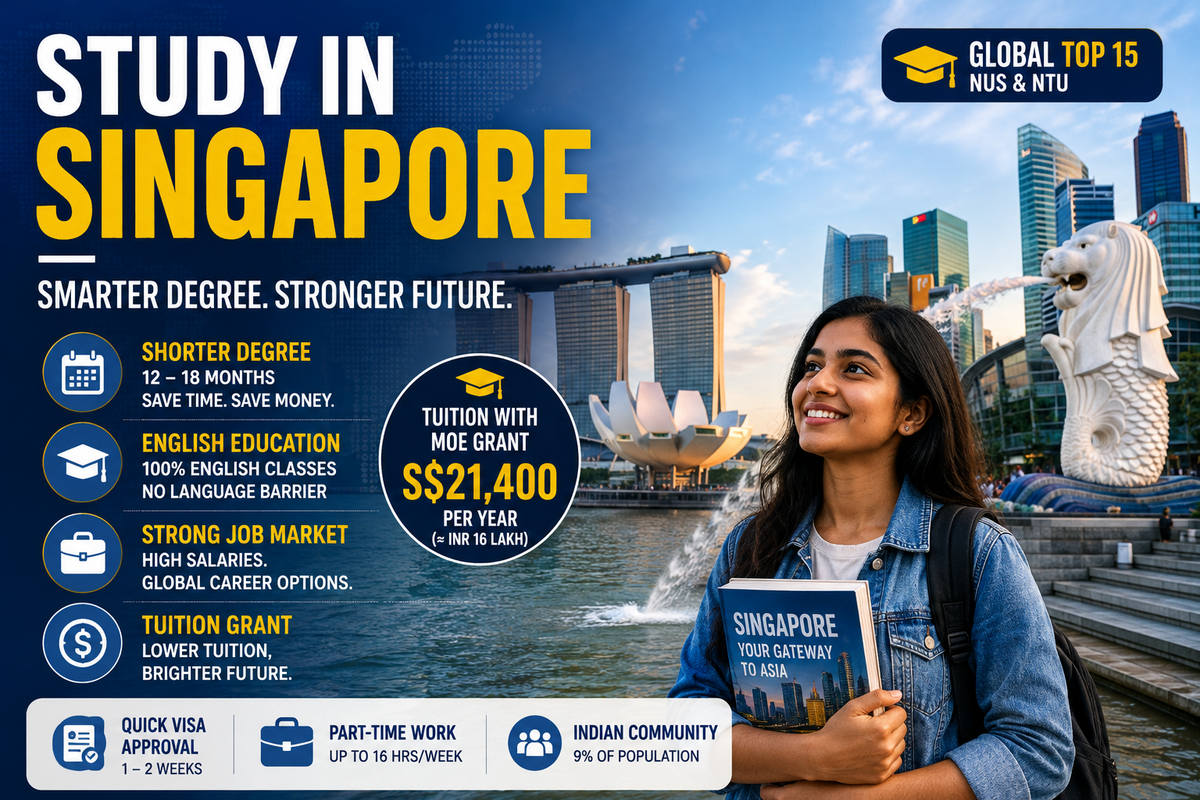
Study in Singapore for Indian students means a short degree, English teaching and a strong Asia jobs market. NUS and NTU sit inside the global top 15. Most Indian students pay around S$21,400 (around INR 16 lakh) a year with the MOE Tuition Grant.
- Singapore suits students who want a quick, job-focused degree, not a long research path.
- The MOE Tuition Grant cuts tuition sharply, but locks you into working in Singapore for three years.
- NUS and NTU remain the top picks for Indian applicants, with SMU strong for finance.
- Treat Singapore as a middle option between a cheap German MS and an expensive US one.
Check Why Study in Singapore: Universities, Deadlines, ROI, Costs and Scholarships
Here is the sharpest number for 2026: US F-1 refusals for Indian applicants crossed 60% in 2025. The Singapore Student Pass clears most Indian files within one to two weeks. That gap decides whether you spend the next year building a career or re-applying.
Quick Facts on Study in Singapore
Hard numbers Indian students need before they shortlist Singapore.
| Parameter | Detail (2026-27) |
|---|---|
| Yearly tuition (NUS or NTU, with Tuition Grant) | S$21,400 to S$30,450 (INR 16 to 23 lakh) |
| Living costs (monthly) | S$1,500 to S$2,400 (INR 1.12 to 1.80 lakh) |
| Student Pass government fees | SGD 105 to 135 (INR 7,850 to 10,100) |
| MOE Tuition Grant bond | 3 years of work in Singapore after graduation |
| English test cut-off (NUS undergrad) | IELTS 6.5 overall or TOEFL iBT 100 |
| Median starting salary (NUS and NTU, 2025) | S$4,746 to S$4,812 (INR 3.55 lakh) per month |
| Employment Pass minimum salary (2026) | S$5,600 (S$6,200 for finance) per month |
Conversions based on an SGD-INR rate of INR 74.77 as of October 15, 2026. Rates fluctuate; check the current rate before financial planning.
- Quick Facts on Study in Singapore
- Why Study in Singapore for Indian Students
- Top Universities in Singapore for Indians
- Best Courses to Study in Singapore
- Cost of Studying in Singapore
- Living Costs for Students in Singapore
- Student Pass and Visa for Indians
- Scholarships Indian Students Can Win
- Admission Deadlines and English Tests
- Jobs, Salaries and Work Pass After Graduation
Why Study in Singapore for Indian Students
Indian students pick Singapore for a short degree, English classes and a strong Asia jobs market in one city. A master’s course finishes in 12 to 18 months. That saves one full year of tuition and rent compared to a US MS. Classes run in English across every public university. There is no second language test to clear beyond IELTS or TOEFL. The schools follow a British-style academic calendar with an August main intake.
NUS ranks 8th globally in the QS World University Rankings 2026, the top university in Asia. NTU sits inside the global top 15. Both pull steady hiring from Google, DBS, Grab, Shopee and the big banks.
- Degree length is 12 to 18 months for most master’s courses.
- Teaching medium is English across all six public universities.
- Student Pass approval runs faster than most Western routes.
- Flight time to India is under 6 hours, which cuts emergency travel costs.
If you want a stable visa process, Singapore wins there too. The Immigration and Checkpoints Authority (ICA) processes most Indian student files in one to two weeks. US F-1 refusals for Indian applicants crossed 60% in 2025. Indians already form 9% of Singapore’s population. Tamil is one of four national languages. That cuts the culture shock Indian students often report in Germany or France.
Key Insight: Singapore is not cheap. The real win is time, not sticker price. One saved year of tuition and rent often pays for the higher annual fee.
If you plan to work in Asia, then a Singapore degree lands you inside the regional hub. That means fewer visa transfers if your first job is in India, Vietnam or Indonesia.
Top Universities in Singapore for Indians
NUS, NTU, SMU, SUTD, SIT and SUSS are the six public autonomous universities Indian students shortlist. NUS and NTU take most of the Indian applications. SMU is the finance-track answer, and SUTD is the design and tech-focused school. The National University of Singapore is the flagship choice. It ranks 8th in the QS World University Rankings 2026 and first in Asia. Engineering, computing, business and medicine are its strongest schools.
Nanyang Technological University is the usual second pick. It is strong on engineering, data science, AI and biomedical sciences. The NTU-NIE track is also the main route for teaching degrees in Singapore.
Public universities at a glance
| University | QS 2026 world rank | Strong areas |
|---|---|---|
| NUS | 8 | Computing, engineering, business, medicine, law |
| NTU | 12 | Engineering, AI and data science, biomedical, design |
| SMU | Not QS top 100 (strong in business ranks) | Business, finance, law, information systems |
| SUTD | Not QS ranked, design-focused | Design, architecture, product engineering |
| SIT | Applied university | Industry-linked engineering, health sciences |
| SUSS | Social sciences focus | Social work, business, communications |
Source: QS World University Rankings 2026 and university sites. SMU is the top specialist school for business and finance tracks.
Indian students also apply to INSEAD Asia and ESSEC Asia-Pacific for business schools. These are branch campuses of top European schools. Fees run higher, but the brand and alumni carry globally.
Best Courses to Study in Singapore
Computing, business, engineering and biomedical sciences give Indian students the strongest return on fees in Singapore. NUS Data Science and Artificial Intelligence ranks 3rd globally in the QS World University Rankings by Subject 2026. That lines up well with hiring in Asia.
The MOE Graduate Employment Survey 2025 shows information and digital technology graduates earned a median starting salary of S$5,500 (around INR 4.11 lakh) per month. Business and engineering tracks sit close behind.
- Computing and AI: NUS BComp, NTU MSc AI, NTU MSc Data Science. Highest median starts.
- Business and finance: SMU BBA, NUS MSc Finance, NTU-NBS MBA.
- Engineering: NUS and NTU Mechanical, Electrical, Civil and Chemical Engineering.
- Biomedical and medicine: NUS Medicine, NTU Lee Kong Chian School of Medicine.
- Design and product: SUTD Engineering Product Development.
Indian student intake leans master’s-heavy. More than 60% of Indian students in Singapore pick MS courses, mostly in data science, business analytics, finance and mechanical engineering.
What students actually say on Reddit: "International students pay much more for the same roles, and many jobs are reserved for locals or PRs." That matches the published Employment Pass salary floor of S$5,600 a month for 2026.
If your plan is a Singapore MBA, then expect fees to run higher. NUS MBA and NTU-Nanyang MBA sit above S$75,000 full tuition. The payoff is salary growth after graduation, not a cheaper degree.
Cost of Studying in Singapore
With the MOE Tuition Grant, Indian students pay around S$21,400 to S$30,450 (around INR 16 to 23 lakh) per year at NUS or NTU. Without the grant, the same courses jump to roughly S$33,400 to S$44,450 a year. The grant halves most tuition, but comes with a 3-year work bond in Singapore after graduation.
NUS undergraduate tuition with Tuition Grant (AY2026-27)
| Course cluster | Tuition per year (SGD) | INR (around) |
|---|---|---|
| Humanities, Sciences, Engineering, Design | S$21,400 | INR 16.00 lakh |
| Business | S$22,200 | INR 16.60 lakh |
| Computing | S$30,450 | INR 22.76 lakh |
| Law | S$30,450 | INR 22.76 lakh |
| Medicine and Dentistry | S$36,750 (much higher at non-subsidised rate) | INR 27.47 lakh |
Source: NUS Office of the Registrar undergraduate tuition fee tables (AY2026-27). NTU tuition tracks a similar structure.
For a full picture across all costs, see this complete cost breakdown for Indian students. Add tuition, living costs and one-time visa fees to get the real yearly budget.
What the MOE grant gives you:
- Tuition at the subsidised rate, roughly 55 to 65% off the full fee.
- Legal right to apply for any Singapore employer post-graduation.
What the grant does not cover:
- Living costs, housing or transport.
- Student Pass fees or security deposit.
- Flights, insurance or books.
Living Costs for Students in Singapore
Plan for around S$1,500 to S$2,400 (INR 1.12 to 1.80 lakh) per month on housing, food and transport. Living costs, not tuition, decide most Indian student budgets. Rent is the single largest line. On-campus hostels run S$800 to S$1,200 (INR 60,000 to 90,000) a month. Private housing nearby runs S$1,000 to S$3,000 (INR 75,000 to 2.24 lakh). Utilities add another S$100 to S$400 a month.
Typical monthly budget (international student)
| Item | SGD per month | INR per month (around) |
|---|---|---|
| Rent (on-campus) | S$800 to 1,200 | INR 60,000 to 90,000 |
| Food (hostel plus eating out) | S$300 to 500 | INR 22,500 to 37,400 |
| Transport (concession pass) | S$48 to 100 | INR 3,600 to 7,500 |
| Utilities and phone | S$100 to 200 | INR 7,500 to 15,000 |
| Books, insurance, misc. | S$150 to 300 | INR 11,200 to 22,400 |
| Total | S$1,500 to 2,400 | INR 1.12 to 1.80 lakh |
Source: Masters Portal 2026 cost guide and NUS student handbook. NUS itself asks international students to plan a minimum of S$19,500 a year for living, which lines up with the lower end above.
Hawker centres are the budget hack most Indian students use. A full meal costs S$3 to S$6. For a deeper look at housing and daily spend, see this guide to living in Singapore: travel and accommodation.
Key Insight: Keep a 5 to 8% currency buffer in your yearly budget. The rupee has slipped against the Singapore dollar in each of the last four years.
If you work the full 16 part-time hours a week during the semester, you can earn roughly S$600 to S$1,000 a month at S$10 to S$15 an hour. That covers food and transport, not rent.
Student Pass and Visa for Indians
The Singapore Student Pass costs around SGD 105 to 135 (around INR 7,850 to 10,100) in government fees and takes one to two weeks to process. Indian students must apply through ICA’s SOLAR portal after the university pre-registers their file.
The institute uploads your details to SOLAR. You get a login and fill in eForm 16. Once ICA approves, you receive an In-Principle Approval (IPA) letter. That letter also contains your entry visa, because Indian nationals need a visa to enter Singapore.
Fees and timelines
- Processing fee: SGD 45 (around INR 3,350).
- Issuance fee: SGD 60 (around INR 4,470).
- Multiple-entry visa (if issued): SGD 30 (around INR 2,240).
- Security deposit for Indians: SGD 5,000 (around INR 3.73 lakh), refundable after the course.
- Processing time: 1 to 2 weeks for Indian nationals.
Source: Immigration and Checkpoints Authority (ICA) 2026 Student Pass fee tables and Wise Singapore student visa guide. For a step-by-step walkthrough, see this Singapore student visa guide with checklist and processing time.
If your file is clean, then approval usually comes in 10 working days. That means you should still apply at least six weeks before travel to cover delays or document fixes.
What the Student Pass gives you:
- Legal right to study full-time at an approved school.
- Up to 16 hours a week of part-time work during the semester, unlimited during the summer break.
- Access to student concession passes for public transport.
What it does not give you:
- Any automatic right to stay after your course ends.
- Work in bars, nightclubs or massage parlours (banned outright).
Scholarships Indian Students Can Win
SINGA, NUS Global Merit Scholarship, Nanyang Scholarship and the Dr Goh Keng Swee Scholarship are the main named awards open to Indian students. Most are highly competitive and need a strong profile. The ASEAN Undergraduate Scholarship does not cover Indian nationals.
The Singapore International Graduate Award (SINGA) is the biggest fully funded option for Indian postgraduates. It is a doctoral programme run by A*STAR with NUS, NTU and SUTD.
Key scholarships for Indian students
| Scholarship | Level | Covers |
|---|---|---|
| SINGA | PhD | Full tuition, stipend SGD 2,000 to 2,500/month, airfare, settling-in allowance |
| NUS Global Merit Scholarship | Undergrad | Full tuition, living allowance, computer, accommodation |
| Nanyang Scholarship (NTU) | Undergrad | Full tuition, living allowance, computer |
| Dr Goh Keng Swee Scholarship | Undergrad | Full tuition, hostel, allowance, airfare |
| SIA Youth Scholarship | Pre-U (Class X) | School fees, exam fees, airfare, monthly stipend |
Source: NUS, NTU and A*STAR scholarship pages (2026 cycle). The SIA Youth Scholarship is for students joining Singapore pre-university programmes after Class X, not for university entry.
Beyond these, each university runs smaller merit-based awards. These usually waive 10 to 30% of tuition and are awarded with the admission offer. There is no separate application.
Key Insight: Treat scholarships as a bonus, not a plan. Build your Singapore budget assuming full tuition. If a scholarship comes, it is upside, not survival.
Admission Deadlines and English Tests
Most AY2027-28 applications open from October 2026 and close between late February and March 2027. The main intake runs in August. NUS, NTU and SMU all follow this cycle. Some business and finance master’s courses also have a January intake.
NUS asks IELTS 6.5 overall with 6.5 in reading and writing. NTU accepts IELTS 6.0 for Standard 12 applicants from India. SMU asks for one standardised test from a longer list including SAT, ACT, IELTS, TOEFL, PTE or C1 Advanced.
English and standardised test cut-offs
| University | IELTS (overall) | TOEFL iBT | Other |
|---|---|---|---|
| NUS undergrad | 6.5 | 92 to 93 | SAT or ACT often needed |
| NTU undergrad (Standard 12) | 6.0 | 85 | Writing 6, Verbal 6 |
| SMU undergrad | 7.0 | 93 | One test from a list |
| SMU Law | 7.5 | 100 | LNAT optional |
| NUS master’s | 6.5 | 100 | Only if medium of instruction was not English |
| NTU master’s | 6.5 | 100 | Test within 2 years of application |
Source: NUS, NTU and SMU admissions sites (2026 cycle). An English-medium school in India may waive the test at NUS, but never automatically. Submit the test unless the school confirms a waiver in writing. For step-by-step guidance, see the admissions guide for Singapore universities 2026 and 2027 and the exam list for Singapore university admissions.
If you miss the main AY2027-28 window, then you can target the January 2028 intake at SMU, NUS and NTU in a few master’s courses. That means Oct-Nov 2027 as the next application cycle.
Education Loans for Singapore Studies
HDFC Credila, Avanse, SBI Global Ed-Vantage and Prodigy Finance are the main lenders Indian students use for Singapore. Loans cover tuition, living costs and travel. Interest rates in 2026 start from around 9.95% a year, floating with the lender’s base rate.
- HDFC Credila: Up to 100% financing, rates from 9.95% a year, repayment up to 15 years.
- Avanse: No upper limit, flexible collateral options, covers tuition and living.
- SBI Global Ed-Vantage: Up to INR 1.5 crore, rates 10.65 to 11.15% a year.
- Prodigy Finance: Collateral-free for select NUS and NTU master’s programmes.
- PNB Udaan and BoB Vidya: Public bank options for lower slabs.
Source: Credila, Avanse, SBI public rate cards (October 2026 slabs). Rates in the table are estimates and change with the RBI repo rate.
Secured loans use property or fixed deposit as collateral and carry lower rates. Unsecured loans run higher but have no collateral risk. For most NUS and NTU admits, lenders offer the full tuition and living budget on the strength of the admit letter.
Key Insight: Lock the loan in before you fly, not after. ICA proof of funds for the Student Pass needs clean bank statements or a sanction letter in your file.
Jobs, Salaries and Work Pass After Graduation
The median starting salary for NUS and NTU fresh graduates was S$4,746 and S$4,812 (around INR 3.55 lakh) per month in 2025. Information and digital technology lead at S$5,500, with medicine graduates topping at S$6,500. Those numbers come from the official MOE Graduate Employment Survey 2025.
Median starting salary by cluster (2025)
| Cluster | Median gross monthly (SGD) | INR per month (around) |
|---|---|---|
| Information and digital technology | S$5,500 | INR 4.11 lakh |
| Medicine (NUS and NTU) | S$6,500 | INR 4.86 lakh |
| NTU business and computing double degree (top) | S$6,950 | INR 5.20 lakh |
| Overall median (six public universities) | S$4,500 | INR 3.36 lakh |
Source: Joint Autonomous Universities Graduate Employment Survey 2025. For a wider salary and ROI view, see this complete ROI analysis of average salaries in Singapore.
Work pass routes after graduation
Singapore does not have an automatic post-study work visa. You switch from the Student Pass to an Employment Pass (EP) or S Pass once you have a job offer.
- Employment Pass (EP): Minimum salary S$5,600 a month in 2026 (S$6,200 in finance). Needs to pass the COMPASS points test.
- S Pass: For mid-skilled roles. Lower salary floor, but subject to quotas.
- LTVP for job search: Short post-graduation window to look for work.
If you accept the MOE Tuition Grant, then you must work for a Singapore-registered employer for three years. That means you cannot take a job in India or the US without buying out the bond.
What students actually say on Reddit: "Post-graduation reality in Singapore is often harder than what is advertised." The S$5,600 EP floor is the main reason. Below that salary, you cannot stay on an EP.
Also Check:
| MBA in Singapore | Study in Singapore After 12th | Affordable Ways to Study at NUS |
| Singapore University Deadlines | Jobs After Studying at NUS | Singapore Study Hub |
Singapore remains a strong, fast-paying study destination for Indian students in 2026-27. The short degree length, English teaching and Asia-wide hiring network give it a specific edge over the US or UK for working-focused applicants. The MOE Tuition Grant lowers the fee, but ties three years of your career to Singapore. Weigh the bond against your long-term plan before signing. For most engineering and computing applicants, the salary floor still clears the loan repayment comfortably.
FAQs
Ques. How much does it cost to study in Singapore for Indian students?
Ans. Around S$31,000 to S$78,000 (INR 23 to 58 lakh) per year. That covers tuition, living and visa fees for a standard undergraduate course at a public university. Medicine and law run higher. With the MOE Tuition Grant, tuition drops to around S$21,400 (around INR 16 lakh) a year.
Ques. Is Singapore cheaper than the US or UK for Indian students?
Ans. Yes on time, mixed on sticker price. A Singapore master’s finishes in 12 to 18 months, versus 2 years in the US. Tuition per year is similar to a mid-tier US school. The real saving comes from one less year of rent, flights and lost salary.
Ques. Can Indian students work part-time while studying in Singapore?
Ans. Yes. You can work up to 16 hours a week during the semester on a Student Pass. Hours are unlimited during holidays. You must be enrolled full-time at an MOM-approved institution. Breaking the rule risks a fine of up to S$20,000 and deportation.
Ques. What is the MOE Tuition Grant and should Indian students take it?
Ans. The Tuition Grant is a Singapore government subsidy that roughly halves international tuition. In return, you must work for a Singapore-registered employer for 3 years after graduation. Take it if you plan to work in Singapore anyway. Skip it only if you want full career flexibility.
Ques. What IELTS score do I need to study in Singapore?
Ans. IELTS 6.5 overall is the common cut-off at NUS undergraduate and most master’s courses. NTU accepts 6.0 for Standard 12 applicants. SMU Law asks for 7.5. TOEFL iBT 92 to 100 is the usual equivalent.
Ques. How do Indian students apply for the Singapore Student Pass?
Ans. The university pre-registers your file with ICA. You then log in to SOLAR and fill eForm 16. ICA issues an In-Principle Approval (IPA) within 1 to 2 weeks. The IPA letter also acts as your entry visa. Government fees run around SGD 105 to 135.
Ques. Can I stay in Singapore after I graduate?
Ans. Yes, with a job offer. You switch from the Student Pass to an Employment Pass. The 2026 minimum EP salary is S$5,600 a month (S$6,200 in finance). There is no automatic post-study work visa like the UK Graduate Route.
Ques. Which university in Singapore is best for Indian students?
Ans. NUS and NTU for most tracks. NUS ranks 8th globally in QS 2026 and leads in computing, medicine and business. NTU is 12th globally and strongest in AI, data science and engineering. SMU is the best fit for finance and business students.
Ques. What are the best scholarships for Indian students in Singapore?
Ans. SINGA for PhDs, NUS Global Merit Scholarship, Nanyang Scholarship and the Dr Goh Keng Swee Scholarship are the main named options. SINGA gives full tuition plus a stipend of SGD 2,000 to 2,500 a month. The ASEAN Undergraduate Scholarship does not cover Indian nationals.
Ques. What salary can I expect after graduating from a Singapore university?
Ans. The median starting salary for NUS and NTU fresh graduates was around S$4,746 to S$4,812 per month in 2025. Computing and digital tech graduates earn S$5,500. The highest-paid group, NTU business-computing double-degree holders, earned S$6,950 a month.
Ques. When should I apply for the August 2027 intake in Singapore?
Ans. Most AY2027-28 application windows open from October 2026 and close between late February and March 2027. NUS graduate research closes in mid-January. SINGA’s August 2027 scholarship deadline is December 1, 2026. Apply at least two months before the deadline to allow time for English tests.
Ques. Is Singapore safe for Indian students?
Ans. Yes. Singapore ranks among the safest countries in the world for international students. Indians already form 9% of the population and Tamil is one of four national languages. Street crime is low, public transport is reliable and most campuses have 24-hour security.



Comments